Fixing an AI-built app before launch usually costs between a few hundred dollars for an automated scan and five figures for full production hardening. Senior-led audits are publicly priced from about $500 to $1,500; fix sprints from about $6,000. The cost depends less on code size than on user data, payments, roles and how tangled the code is.
[ Key takeaways ]
Start with an audit: it turns an open-ended “fix my app” into a fixed list with a price.
Published market prices in October 2026: automated audits $49–$299, senior-led audits about $500–$1,500, fix sprints from about $6,000, full go-live hardening from about $14,000.
Payments, multiple user roles, personal data and AI features raise the cost more than the number of screens.
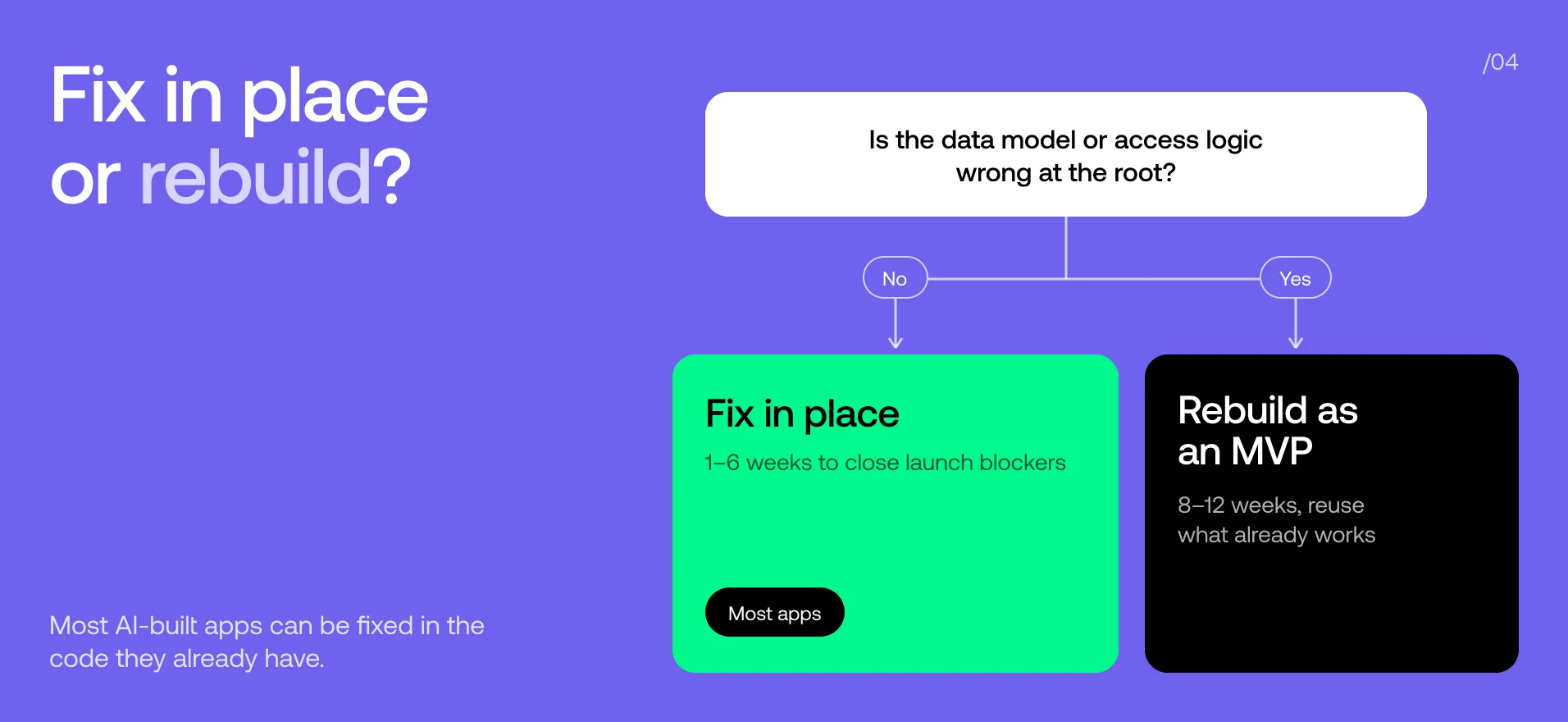
Most AI-built apps can be fixed in place; a rebuild makes sense only when the data model or access rules are fundamentally wrong.
You can cut the bill by running the built-in security scan, rotating exposed keys and writing down your user roles before anyone starts.
Have a project in mind? Talk to Ruben, our Chief Sales Officer.
Market prices for auditing and fixing apps built with Lovable, Bolt, Replit and Cursor, what drives the cost up, and how to spend less before you launch.
You built a working app with Lovable, Bolt, Replit or Cursor in weeks. Now real users, a payment provider or an investor are about to look at it, and you want to know what it costs to make it safe. This guide gives you market prices with sources, what moves the number up or down, and how to avoid paying for work you do not need.
How much does it cost to fix an AI-built app?
Most founders pay in two steps: an audit that finds and prices the problems, then a fix. Based on prices that providers publish on their own websites (checked 30 October 2026), the market looks like this:
Published market prices for auditing and fixing AI-built apps
Automated scan with a short report — Published price range: $49–$299; Typical time: 24–48 hours; What you get: Tool-driven list of known issues; little or no business context
Senior-led audit — Published price range: about $500–$1,500; Typical time: 3–5 working days; What you get: A senior engineer tests your app and code, ranks risks, recommends fix or rebuild
Broader code and delivery audit — Published price range: about $5,000–$15,000; Typical time: not always published; What you get: Code, infrastructure and team process; often for investors or acquirers
Fix / rescue sprint — Published price range: from about $6,000; Typical time: about 2 weeks; What you get: Launch blockers closed: secrets, server-side auth, error handling, tests on key paths
Full go-live hardening — Published price range: from about $14,000; Typical time: 4–6 weeks; What you get: Production-ready app: policies, auth, payments, tests, monitoring, backups
Rebuild as a new MVP — Published price range: UK MVPs from about £8,000 at Fourmeta; market ranges vary widely; Typical time: 8–12 weeks; What you get: New codebase that reuses what works
Sources for the ranges: an automated audit service ($49), a scan-and-report service ($299, 48 hours), a fixed-price rescue studio ($500 one-week audit, go-live from $14,000 over 4–6 weeks), a rescue agency ($1,500 three-day audit, rescue sprint from $6,000, rebuild from $18,000), a 2026 survey of code-audit prices ($49 to $15,000, most startups in the $950–$5,000 band). Fourmeta MVP price from /mvp-development. Prices change; treat them as a market map, not a quote.
At Fourmeta, the vibe-coded app audit is a fixed £490 with the report in two working days; launch blockers are then closed in a fixed-price Vibe-to-Production sprint for £4,900.
Why do prices range from $49 to $15,000?
Because the price mostly reflects how many hours a senior engineer spends inside your system, and whether a person reads your code at all. A $49 report is generated by tools. A $1,500 audit is a few days of a senior engineer testing your real flows with two accounts. A $10,000 audit adds infrastructure, team process and documentation for an investor or buyer.
The gap matters because the most expensive problems in AI-built apps are not syntax errors a scanner can see. They are business-logic and access problems: one customer seeing another customer’s data, a payment marked as successful from a redirect URL, an admin action that is hidden in the interface but open in the API. Finding those requires someone who understands what the app is supposed to do.
Stat callout: In one 2025 scan of 1,645 public Lovable projects, 170 (about 10.3%) had database endpoints with row-level security settings that let visitors read or write data they should not. — Matt Palmer, Statement on CVE-2025-48757
What drives the cost of fixing a vibe-coded app?
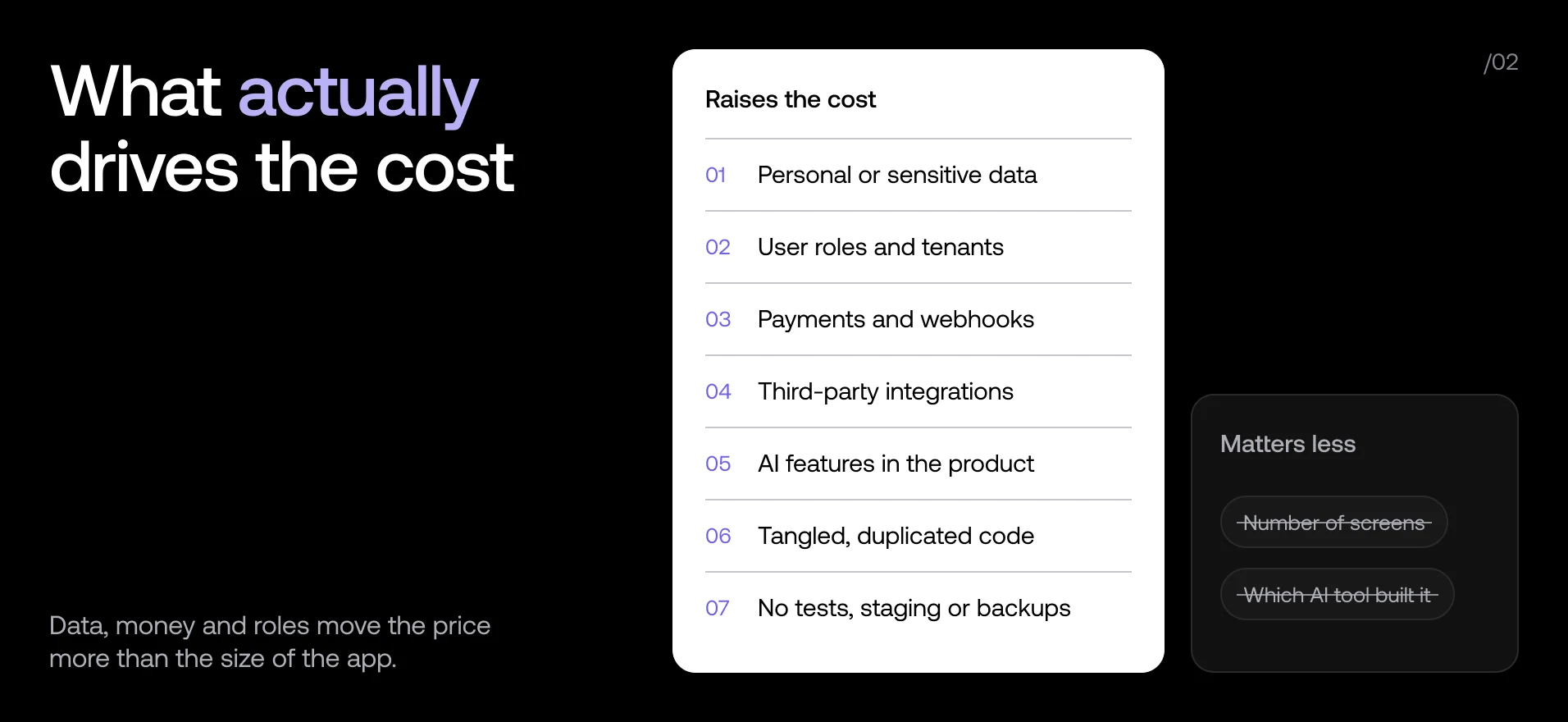
Seven factors explain most of the difference between a small and a large fix. In order of impact, from our reviews [VERIFY: порядок по реальным аудитам команды]:
Personal or sensitive data. If the app stores customer details, health, financial or children’s data, every table and storage bucket needs correct access rules and a test that proves them.
Number of user roles and organisations. One user type is simple. Admins, team members, invited guests and multiple companies (tenants) multiply what can go wrong — and what must be tested.
Payments and money-moving flows. Subscriptions, credits, refunds and webhooks need server-side verification and protection against duplicate or replayed events.
Integrations. Each third-party API adds keys to protect, limits to respect and failure modes to handle.
AI features inside the product. If your app calls an LLM, you need cost caps, prompt-injection defences and limits on what the model is allowed to do.
How tangled the code is. Apps built prompt by prompt often repeat the same rule in many places. Fixing it once is cheap; fixing it in twelve slightly different copies is not.
Whether tests, staging and backups exist. Without them, every fix has to be verified by hand, and some cannot be released safely until the basics exist.
What matters less than founders expect: the number of screens and which tool generated the code.
Should you get an audit first or go straight to fixing?
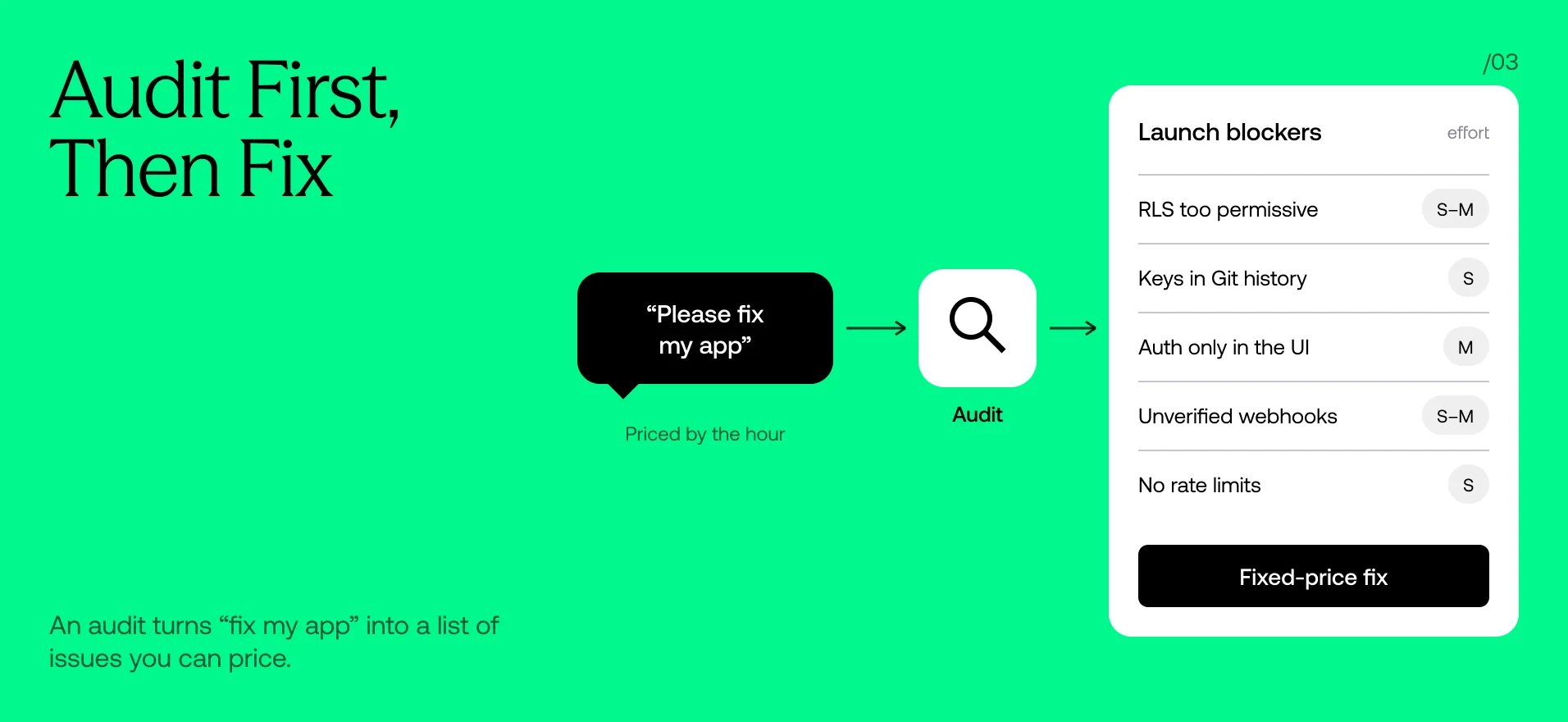
Get an audit first unless the problem is a single, known bug. An audit turns “please fix my app” — which a developer can only price hourly — into a list of specific issues, each with an effort estimate, which can be priced as a fixed-scope job. It also stops you paying to polish code that the audit would have told you to replace.
Go straight to a fix only when you already know exactly what is broken (for example, “the Stripe webhook is not verified”) and the rest of the app has been reviewed recently.
A practical rule: if a provider will not give you a fixed price for the fix after the audit, ask why. A good audit should make the fix predictable.
What does each typical fix involve?
The table below shows what the most common fixes involve and their relative effort. It is not a quote; effort depends on how many places in your code are affected.
Common fixes in AI-built apps and relative effort
Row-level security off or too permissive — What the fix involves: Write per-table policies, test as two users, fix queries that relied on open access; Relative effort: Small to medium
Secret keys in the browser or Git history — What the fix involves: Revoke and rotate keys, move privileged calls to server functions, add secret scanning; Relative effort: Small
Authorisation only in the interface — What the fix involves: Add server-side checks to every protected action, deny by default, add negative tests; Relative effort: Medium
Unverified payment webhooks, prices from the client — What the fix involves: Verify signatures, look prices up on the server, make handlers idempotent; Relative effort: Small to medium
No rate limits or cost caps on AI, email, sign-up — What the fix involves: Limits per user and IP, quotas, spend alerts; Relative effort: Small
Same business logic duplicated across components — What the fix involves: Consolidate into one tested module, remove copies; Relative effort: Medium to large
No tests on critical paths — What the fix involves: Add end-to-end tests for sign-up, payment and the core job; Relative effort: Medium
One environment, no rollback — What the fix involves: Add staging, separate keys, deployment and rollback procedure; Relative effort: Medium
No monitoring or restorable backups — What the fix involves: Error tracking, alerts to a named person, a tested restore; Relative effort: Small to medium
Data model that cannot support the next stage — What the fix involves: Redesign schema and migrate data; often the trigger for a partial rebuild; Relative effort: Large
[TEAM: если готовы — добавить колонку «Typical time at Fourmeta» в днях по реальным проектам. Не выдумывать.]
Is it cheaper to fix yourself, hire a freelancer, use an agency or rebuild?
It depends on what is at stake. Fixing yourself is cheapest in cash and most expensive in risk if you do not know what to look for. A freelancer is cheaper per hour but you need to know what to ask for. An agency costs more per day but should give you a fixed scope and a second pair of eyes. A rebuild is the most expensive and only pays off when the foundation is wrong.
Options compared
Fix it yourself with the AI tool — Typical cost basis: Your time + tool credits; Speed: Fast for known issues; Main risk: You fix the symptom the tool shows you, not the access rule you cannot see; Makes sense when: Prototype with no real users or data yet
Freelancer — Typical cost basis: Upwork lists median full-stack rates around $16–$35/hour; UK contract web developers have a median of about £463/day (IT Jobs Watch, Oct 2026); Speed: Depends on availability; Main risk: Quality varies; scope creeps without an audit; Makes sense when: You have an audit report and a clear list
Specialist agency or studio — Typical cost basis: Fixed audit + fixed-price fix (see Table 1); Speed: 1–6 weeks; Main risk: Higher day rate; Makes sense when: You are about to launch, take payments or raise
Rebuild as a new MVP — Typical cost basis: Project price; UK MVPs from about £8,000 at Fourmeta; Speed: 8–12 weeks; Main risk: You pay again for features that already work; Makes sense when: Data model or access logic is wrong at the root
Senior contractor rates in the UK average about £604/day according to YunoJuno’s 2025 rates report — a useful benchmark when comparing an agency quote with hiring someone yourself.
What does it cost not to fix it?
The cost of an unfixed AI-built app shows up as an incident, not an invoice. Public cases show the pattern:
Exposed data. In the Lovable row-level-security case (CVE-2025-48757), exposed data in vulnerable projects included emails, phone numbers, payment details and API keys.
Leaked secrets at scale. Escape’s 2025 scan of more than 5,600 public vibe-coded apps found 2,000+ highly critical vulnerabilities, 400+ exposed secrets and 175 instances of personal data, including medical records and bank details.
Lost production data. In July 2025, an AI coding agent deleted a live production database during a code freeze in a widely reported incident; the data was later restored, but only because rollback turned out to work.
One honest caveat: you will often read that a bug costs “100 times more” to fix in production. That figure traces back to old, poorly documented sources and has been widely questioned. The real reason to fix before launch is simpler: before launch you choose when to fix; after an incident, your users, investors or regulator choose for you.
How can you reduce the cost before anyone starts?
You can save several days of paid work by doing five things yourself first:
Run the built-in scanner. Lovable runs a quick security scan on every publish and offers a deeper scan on demand; fix what it flags. Its own documentation says these scans do not replace a professional review for apps handling sensitive data — but they remove the obvious items.
Check which keys you ship. In Supabase, publishable (anon) keys are designed to be public and rely on row-level security; secret (service-role) keys bypass it and must never reach the browser. If a secret key was ever in client code or Git, revoke and rotate it.
Write down your roles. One page: who the users are, what each role may see and change. This is the most useful document an auditor can receive.
Create two test accounts in different organisations or teams, so the auditor can try to reach one from the other.
Freeze features for the audit week. Every new prompt during the audit changes what is being audited.
How does Fourmeta price an AI-built app audit and fix?
Fourmeta, a London-based AI engineering studio, prices this work in fixed steps:
Audit: £490, report in two working days. A written report, a founder summary and a walkthrough call, ending with one decision: launch, fix, refactor or rebuild.
Vibe-to-Production sprint: £4,900, about two to three weeks [VERIFY]. We close the launch blockers, retest and hand back the code in your repository. [DECIDE: audit fee credited against the sprint?]
Production care: £1,500 a month after launch: monitoring, security updates, fixes and small features.
Rebuild as an MVP: from £8,000 when the audit shows the foundation will not hold. We reuse what works.
Budget for an audit first and a fixed-price fix second. For most AI-built apps that are close to launch, the fix is a matter of weeks, not a rebuild — as long as someone checks data access, keys, payments and roles before your users do.
alex-rodukov
audit
Frequently asked questions
How much does a code audit for a Lovable or Bolt app cost?
Published prices in October 2026 range from $49–$299 for automated or lightly reviewed reports to about $500–$1,500 for an audit where a senior engineer tests your app and code over several days. Broader audits for investors or acquirers can cost $5,000–$15,000. Choose based on what is at stake: real user data and payments justify a senior-led review.
How much does it cost to fix a vibe-coded app?
It depends on what the audit finds. Published fix or rescue sprints start from about $6,000 for two weeks of work on launch blockers, and full go-live hardening from about $14,000 over four to six weeks. Small, known issues such as a missing webhook check can cost far less. Ask for a fixed price based on the audit findings.
Is it cheaper to rebuild an AI-built app from scratch?
Rarely. Most issues in AI-built apps — permissive database rules, exposed keys, missing server-side checks — can be fixed in place. A rebuild pays off only when the data model or access logic is wrong at the root, or when safe changes cost more than replacement. Even then, keep the screens, flows and lessons that already work.
Can I fix my Lovable app myself?
Yes, for known issues: run the built-in security scan, enable row-level security, rotate any exposed keys and move secret keys to the server. What is hard to do yourself is proving that one user cannot reach another user’s data or that payments cannot be faked. If you handle personal data or money, have someone independent check before launch.
How long does it take to fix an AI-built app before launch?
An audit typically takes three to five working days, based on published offers. Fixing launch blockers usually takes one to six weeks, depending on payments, user roles, integrations and how tangled the code is. A rebuild as a new MVP typically takes eight to twelve weeks. Freezing new features during the fix shortens every stage.
Alex Rodukov is the CEO and founder of Fourmeta, a London-based AI-native product agency. He works directly with founders on AI products, MVPs and security audits of AI-built apps, from the first scope to launch and beyond.
Subscribe for insights, service updates, and a closer look at the world of Fourmeta®
Discover firsthand experiences from our clients about their journey with Fourmeta®Agency—insights into our collaboration, expertise, and results delivered.
Thank you for subscribe!
Oops! Something went wrong while submitting the form.