In 2026 a UK MVP built by a professional team costs £8,000–£18,000 for a simple single-platform product, £18,000–£30,000 for a medium build with a custom backend and core integrations, and £30,000+ for a complex multi-platform product with AI, multiple user roles or sector compliance. Typical timelines are 6–10, 10–16 and 16–24+ weeks. Budget a further 20–30% of the build cost per year for hosting, monitoring and iterations.
Every founder eventually asks the same question: how much does it cost to build a minimum viable product? And almost every answer on the internet either ducks it or gives you a range so wide it's useless.
This guide is different. It gives you real mvp development cost figures for the UK in 2026, explains what drives the numbers, and helps you make smarter decisions before you've spent a penny.
First: what counts as an MVP in 2026?
A minimum viable product is not a prototype or a demo. It is a working, shippable product with the smallest possible feature set that still solves a real problem for real users. The point is not to build something cheap, it is to build something you can learn from.
Prototypes and proofs of concept are cheaper and faster, but they don't give you the data you actually need: activation rates, retention, drop-off points. An MVP does. That distinction matters because it directly shapes the development cost of MVP projects, and it determines whether the money you spend produces insight or just noise.
If someone quotes you £4,000 for an MVP, they are almost certainly quoting you a prototype. That is fine, but know what you are buying.
Cost of MVP development UK: real numbers by tier
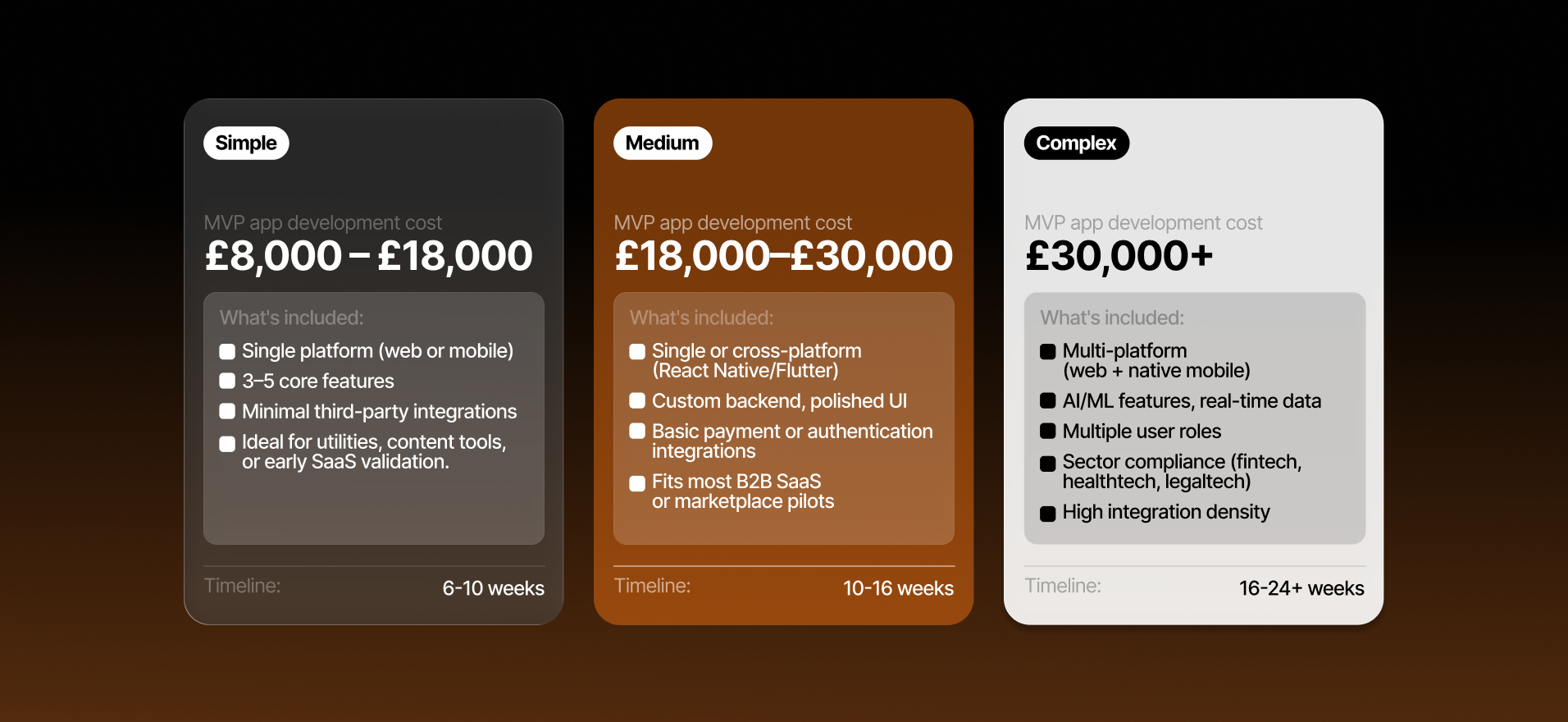
Here is a straightforward MVP development cost estimate breakdown based on complexity tier. These figures reflect UK market rates in 2026 with professional design, engineering, and QA included.
Simple MVP: £8,000–£18,000, 6–10 weeks
Single platform (web or mobile)
3–5 core features
Minimal third-party integrations
Best for utilities, content tools and early SaaS validation
Medium MVP: £18,000–£30,000, 10–16 weeks
Single or cross-platform (React Native or Flutter)
One thing the table won't tell you: plan for post-launch costs. Cloud hosting, monitoring, support, and iterative improvements typically add 20–30% of the build cost per year. Factor that into your runway before you kick off.
What actually drives MVP development cost
Understanding your cost of MVP development means understanding what levers move the number. Here are the ones that matter most.
Platform choice
This is the single biggest variable. A web-first MVP is the cheapest and fastest path to market, typically starting at £8k. Progressive web apps now support push notifications and offline mode, so for most early products, native apps are unnecessary.
Cross-platform builds using Flutter or React Native reduce the cost of native mobile by 30–40%, since one codebase covers both iOS and Android. Native mobile (separate iOS and Android codebases) is the most expensive option, reserved for products that genuinely need deep hardware integration or peak performance.
Scope and feature count
Every feature you add is a multiplier, not an addition. It adds design time, build time, QA time, and ongoing maintenance. A ruthless feature prioritisation process, using frameworks like MoSCoW or RICE, can dramatically reduce your MVP development cost without reducing what you learn. Ask yourself: does this feature generate a signal I can act on? If not, it does not belong in v1.
Integrations and APIs
Payment gateways, mapping services, CRM connections, and authentication providers all add time and cost. Each integration introduces security and compliance obligations, requires testing across edge cases, and may carry licensing fees. Use managed services (Stripe, Auth0, Twilio) wherever possible, the licensing cost is almost always lower than building it yourself.
AI and data features
Basic analytics instrumentation, like tracking sign-ups, activation, and feature usage, is inexpensive and should be in every MVP. Custom AI models or features built on large language models are another matter. They require specialist engineering talent and carry ongoing inference costs. If AI is central to your product, budget for model and inference costs explicitly; they can be significant and are often underestimated at the MVP stage.
Compliance and security
If your MVP handles personal data, financial transactions, or regulated content, budget for it properly. Secure coding practices, penetration testing, data protection assessments, and legal review are not optional extras. Discovering compliance gaps after launch is significantly more expensive than building correctly from the start. If you are in fintech, healthtech, or legaltech, this line item will be substantial, so plan for it upfront.
Team composition
The cheapest hourly rate rarely produces the lowest final cost. Freelancers transfer the project management, architecture, QA, and integration burden to you. Unless you have a strong technical co-founder, the hidden overhead usually exceeds the apparent savings. A specialist MVP development company with a cross-functional team, including designers, engineers, QA, and a product manager, generally delivers faster, more predictable results.
A simple MVP development cost calculator framework
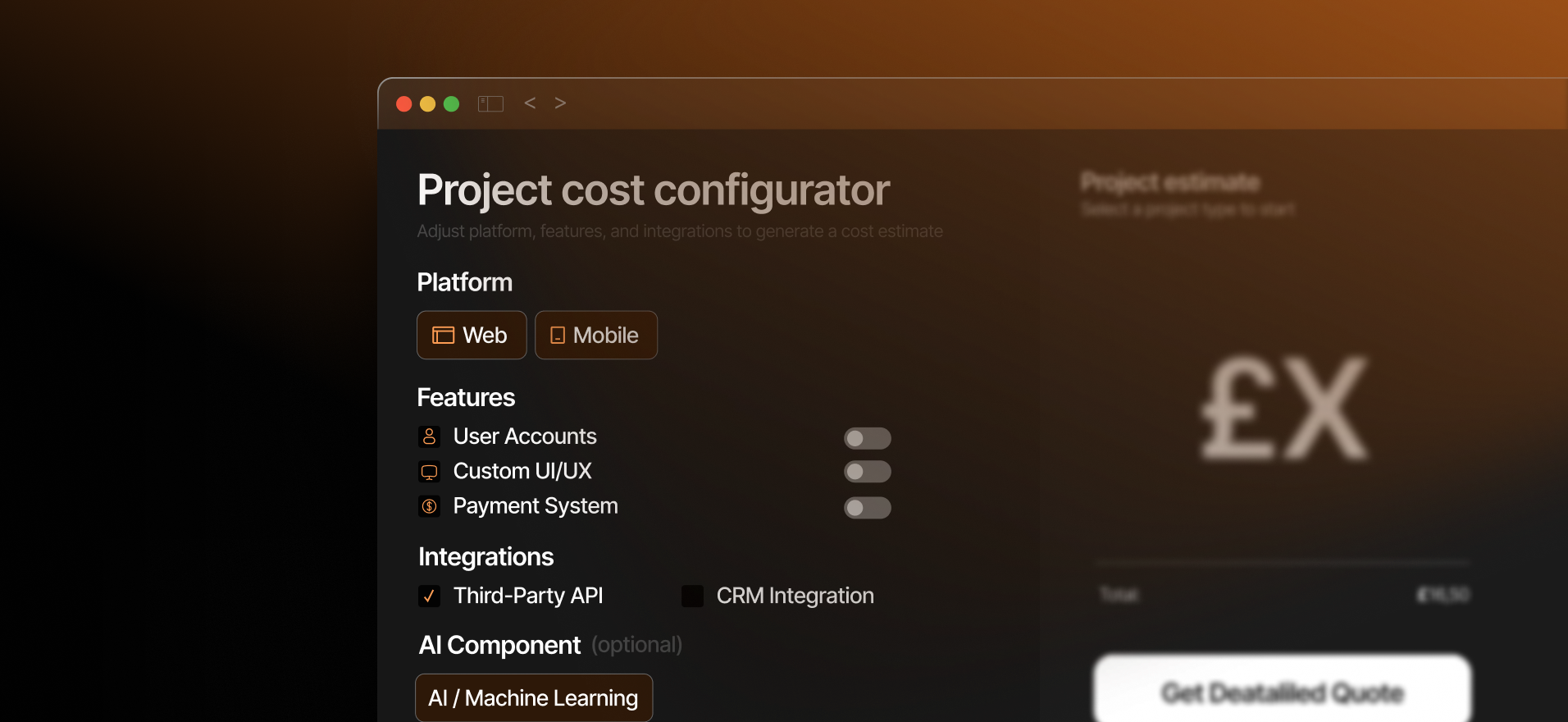
You will find various mvp development cost calculator tools online, but most are black boxes. A better approach is to use a transparent cost-building framework you can interrogate. Here is how to build your own estimate:
Start with your platform decision: web-first, cross-platform mobile, or native mobile.
Add feature complexity. Each major user journey (onboarding, core action, billing) adds roughly £3k+ depending on the depth of logic required.
Add integrations. Each significant third-party API (payment, mapping, CRM) adds £2k+ once security and testing are included.
Add compliance overhead if applicable.
Add design. Budget 15–25% of total build cost for discovery, UX research, wireframes, and a design system. Cutting this increases development rework costs downstream.
Add post-launch operations. Hosting, monitoring, and support at 20–30% of build cost annually.
If your rough total comes out under £8,000, you are almost certainly scoping a prototype, not an MVP. If it comes out over £100,000, you may be scoping a version 2 product, reassess what the actual minimum is.
How to reduce MVP app development cost without reducing learning
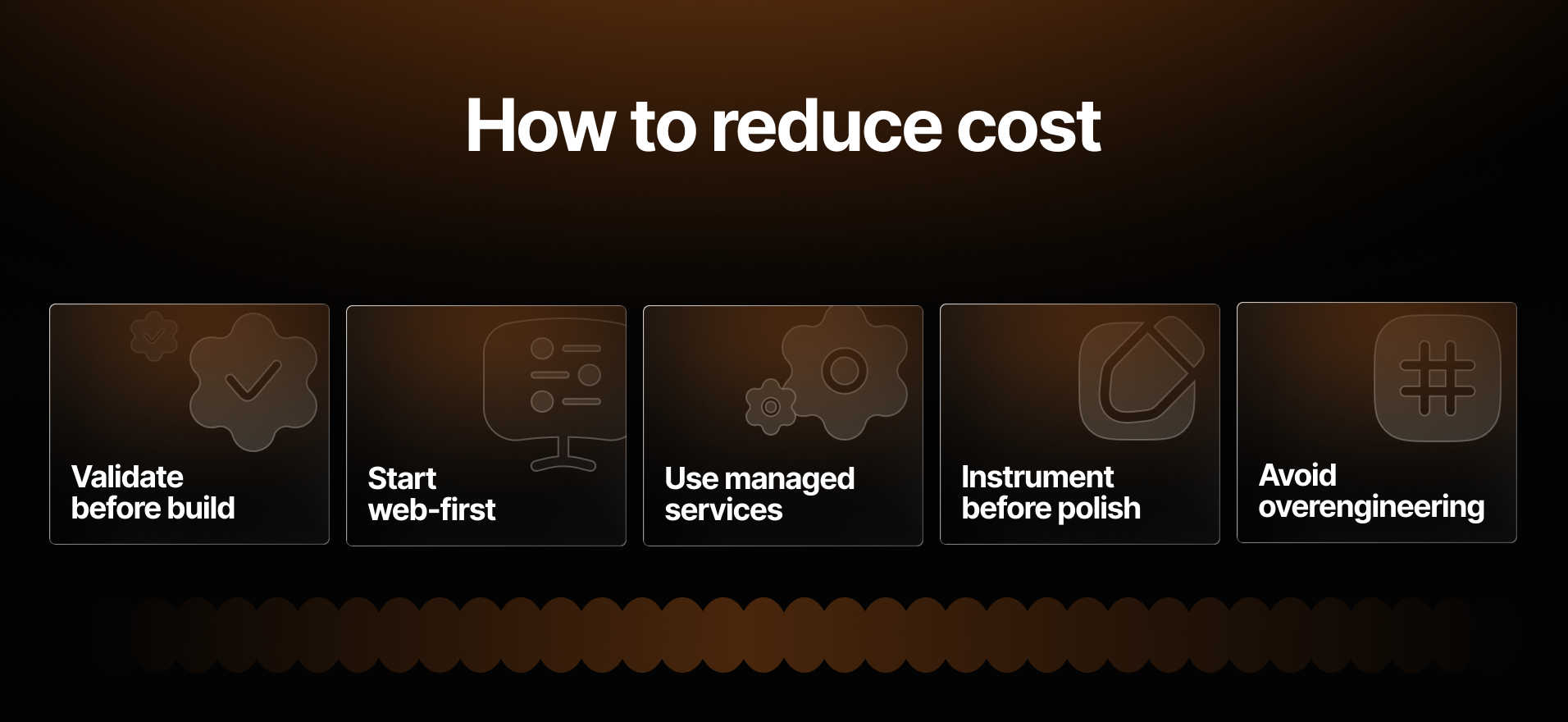
Reducing cost does not mean building a worse product. It means being surgical about what generates learning and deferring everything else. Here is what actually works:
Validate before you build. Customer interviews, competitor analysis, and a no-code smoke test can save you tens of thousands by revealing what users actually want. A week of discovery is worth a month of development.
Start web-first. Unless your product genuinely requires native device capabilities, a web app gets you to users faster and cheaper. You can build native later when you have data to justify it.
Use open-source and managed services. Authentication, payments, email, and storage are solved problems. Do not pay to rebuild them. The real cost of those modules is not the code, it is the QA and maintenance.
Instrument before you polish. Ship with analytics in place. Only refine the UI when usage data confirms users care about that flow. Many MVPs waste budget polishing features that get abandoned at launch.
Avoid premature scaling. Multi-region infrastructure, complex caching, multi-currency support, and advanced role-based access are not MVP features. Build to a level that works at your expected user volume, not the volume you hope to reach in three years.
Choosing the right MVP development partner in the UK
Your partner choice shapes your cost, your timeline, and the quality of what you learn. A few things to assess:
Do they insist on a discovery phase? A reputable team will want to define user journeys, feature scope, and a tech stack before quoting you a fixed number. Any quote that skips it is a guess.
Is the team genuinely cross-functional? You need design, engineering, and QA under the same roof. An agency that only provides developers is offloading product decisions to you, fine if you have a strong product person, risky if you do not.
Do they provide a full handover? Insist on access to all Figma files, design systems, and documented repositories. Agree on IP ownership in writing before work starts. This is standard, any reluctance is a red flag.
Is support flexible? Early-stage startups rarely need a rigid 12-month retainer. Look for partners who offer ad-hoc iterations and maintenance without lock-in.
Watch for red flags: unrealistically low quotes, vague estimates with no discovery, reluctance to discuss IP, and aggressive upselling of features at the scoping stage.
Timelines: how long will your MVP take?
Time-to-market is a cost in itself. Every month of development is a month you are not learning from real users.
A simple MVP takes 6-10 weeks. Medium complexity, 10-16 weeks. Complex builds with compliance or AI components, 16-24 weeks or more. The most common delays are decision delays. Undefined requirements, late compliance reviews, and slow stakeholder feedback are responsible for most timeline overruns. Clear product ownership and fast feedback loops prevent this. Build a decision log from day one.
Frequently asked questions
How much does an MVP cost in the UK in 2026?
With professional design, engineering and QA included, a simple single-platform MVP costs £8,000–£18,000, a medium build with a custom backend and basic integrations £18,000–£30,000, and a complex multi-platform product with AI, multiple user roles or sector compliance £30,000+. Most startup MVPs with Fourmeta start from £8,000.
How long does it take to build an MVP?
A simple MVP takes 6–10 weeks, medium complexity 10–16 weeks, and complex builds with compliance or AI components 16–24 weeks or more. Most delays come from decisions, not code: undefined requirements, late compliance reviews and slow stakeholder feedback.
How much does an MVP cost to run after launch?
Plan for 20–30% of the build cost per year for cloud hosting, monitoring, support and iterative improvements, and include it in your runway before development starts.
Why are some MVP quotes under £8,000?
A quote of around £4,000 is almost always for a prototype or a demo, not an MVP. A prototype is fine for testing an idea, but it will not give you the activation, retention and drop-off data that a working MVP produces.
Does adding AI make an MVP more expensive?
Basic analytics is inexpensive and belongs in every MVP. Custom AI models or features built on large language models need specialist engineers and carry ongoing inference costs, so budget for them explicitly. They usually move a product into the complex tier.
How can I reduce MVP development cost?
Validate the idea before building, start web-first, use managed services for authentication, payments, email and storage, ship with analytics before polishing the UI, and avoid premature scaling. Cut features that do not produce a signal you can act on.
The bottom line
The cost of MVP development in the UK in 2026 ranges from £8,000 for a simple single-platform product to over £30,000 for a complex multi-platform build with AI, integrations, and compliance requirements.
The MVP development cost that matters, though, is not just what you spend, it is what you learn per pound spent. An expensive MVP with clear instrumentation and a tight feedback loop is a better investment than a cheap one that teaches you nothing. Scope ruthlessly, validate early, choose your partners carefully, and build only what you need to answer the questions that matter most right now.
Everything else can wait for version 2.
Note: All cost figures in this article are indicative and reflect UK market rates in 2026. Actual costs vary based on agency, team location, specification changes, and third-party integration requirements. Always obtain a detailed scoped estimate before committing a budget.
Subscribe for insights, service updates, and a closer look at the world of Fourmeta®
Discover firsthand experiences from our clients about their journey with Fourmeta®Agency—insights into our collaboration, expertise, and results delivered.
Thank you for subscribe!
Oops! Something went wrong while submitting the form.




.avif)

























.avif)


