The seven website mistakes that scare off investors are a murky value proposition above the fold, a site that breaks on mobile, slow speed, proof without evidence, too many paths with no clear next step, pricing and contact friction, and missing SEO and trust basics. Each can be fixed fast, within a one-week investor-readiness sprint.
[ Key takeaways ]
Make your H1 one sentence naming who it is for, the outcome they get and how you deliver it.
Review top pages at 360–414px widths and make tap targets at least 44px.
Keep the hero under about 250KB and aim for LCP under 2.5s and CLS under 0.1 on mobile.
Back claims with a proof trio: a recognizable logo row, a case metric and a named testimonial.
Give every page a unique title of up to 60 characters and a meta description of up to 160.
Have a project in mind? Talk to Ruben, our Chief Sales Officer.
If you’ve got investor meetings on the calendar, your website is part of the pitch—whether you plan on showing it or not. VCs will Google you on the train, open your site on a phone, and decide in seconds if you’re a team that ships or a team that… talks. The bar in 2025 isn’t perfection; it’s clarity, speed, and proof. Below are the seven website mistakes that quietly kill confidence—and how to fix each one fast (yes, in a week, especially if you’re on Webflow). (If you want the shortcut, our Startup Launch Pack bundles strategy, UX/UI, and Webflow build into one sprint. Launch Faster. Launch Right.)
1) A murky value prop above the fold
Investors don’t have time to decode clever copy. If a stranger can’t repeat what you do after one glance, that vagueness gets mapped to everything else—go-to-market, roadmap, even hiring.
Fix it fast: Write one sentence that names who it’s for, what outcome they get, and how you deliver it. Make that your H1. Put one primary CTA next to it (Book a demo / Start trial). Save the poetry for your Series B party.
2) Looks good on desktop, breaks on a phone
Most diligence is mobile. A cramped hero, tiny tap targets, or a form that scrolls off-screen tells an investor you optimize for Dribbble, not revenue.
Fix it fast: Review your top pages at 360–414px widths. Increase tap targets (≥44px), trim the hero copy, stack content cleanly, and make the CTA impossible to miss. If it reads well on a phone, it will sing on desktop.
3) Speed drag
Nothing says “expensive growth” like a slow site. If your first paint lags, investors assume your funnels leak and your CAC is higher than it should be.
Fix it fast: Compress images (WebP/AVIF), lazy-load everything below the fold, keep the hero under ~250KB, and kill heavy animations that don’t earn their keep. Aim for LCP < 2.5s and CLS < 0.1 on mobile. It’s not glamorous, but neither is wasted ad spend.
4) Proof that isn’t… proof
Endless adjectives without evidence read like hand-waving. Investors want to see who believes you and what happened when they did.
Fix it fast: Add a recognizable logo row, one short case snapshot with a number (“+32% sign-ups in 90 days”), and a human quote with name and title. That trio—logos, metric, testimonial—does more for credibility than ten badges.
5) Too many paths, no obvious next step
A nav with nine items, three CTAs in the hero, and dead-end sections tell investors your site wasn’t designed to convert—so your funnel probably isn’t either.
Fix it fast: Choose one primary action and repeat it: header, hero, mid-page, footer. Reduce the nav to the essentials (Home, Product/Features, Pricing, Case Studies, About). Link deeper details from the product page; don’t clutter the hero.
6) Pricing and contact friction
Hidden pricing and long forms smell like fear. They also choke signal: fewer conversations, less data, slower learning.
Fix it fast: If you can’t list full pricing, use “from” tiers to set expectations. Keep the hero form to Name + Work Email (add company/URL if you must). Embed Calendly next to it for instant bookings. Let speed be your first impression.
7) Foundations missing: SEO, trust, and basics
Investors notice the seams: no privacy page, broken 404, identical titles across pages, images without alt text. Sloppy foundations hint at sloppy execution elsewhere.
Fix it fast: Give every page a unique title (≤60 chars) and meta description (≤160). One H1 per page. Descriptive alts for images. Clean, human URLs (/pricing, /case/askflow). Publish Privacy/Terms, show your company info in the footer, and add a compliant cookie banner. Ship a branded 404 with a CTA back to “Book a demo.”
A one-week investor-readiness sprint
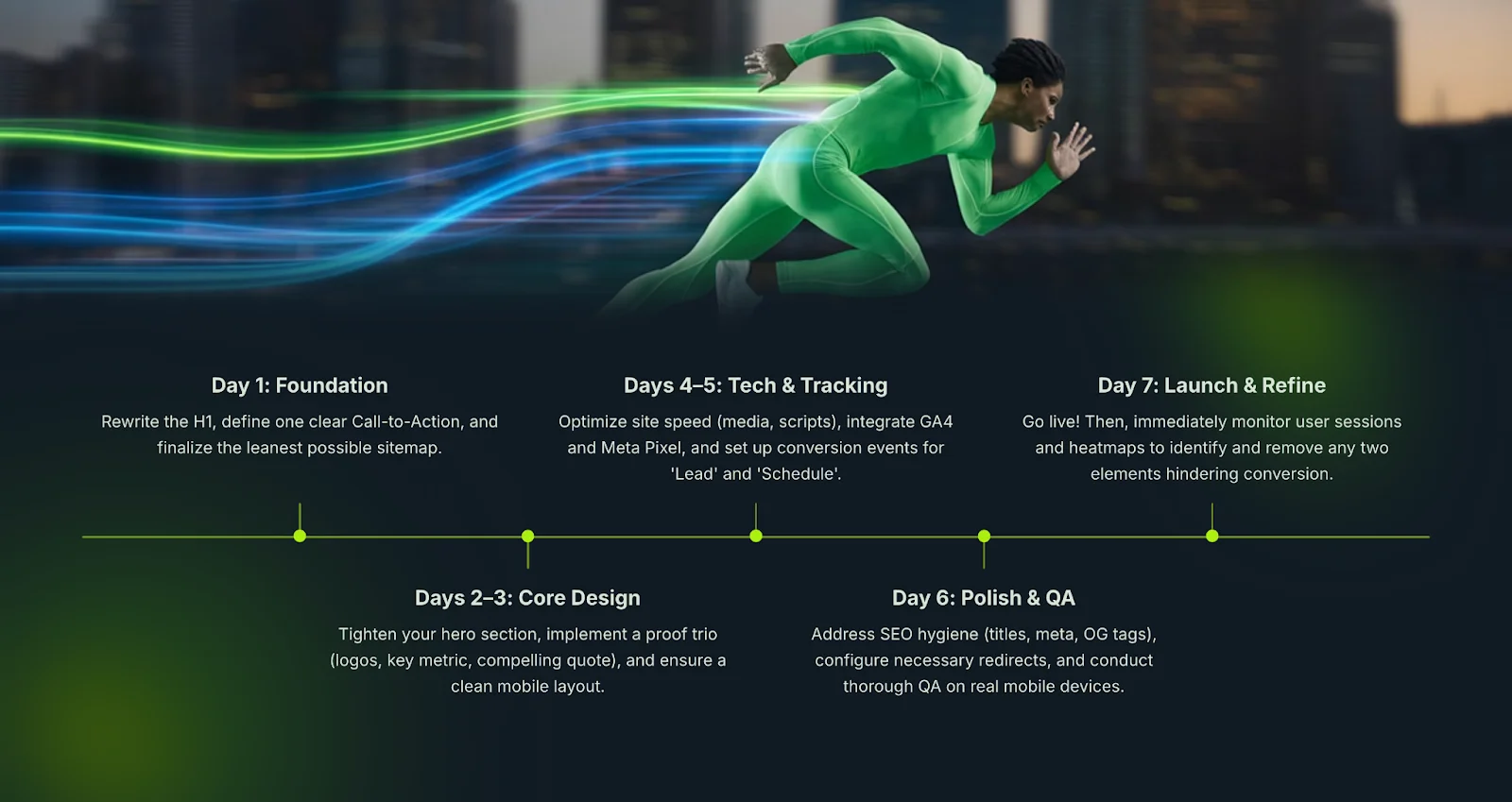
Day 1: Rewrite the H1, pick one CTA, agree the lean sitemap.
Days 2–3: Tighten hero, add proof trio (logos + metric + quote), clean mobile layout.
Days 4–5: Fix speed (media + scripts), wire GA4 + Meta Pixel, add events for Lead and Schedule.
Day 6: SEO hygiene (titles/meta/OG), set redirects, QA on real phones.
Day 7: Publish, watch sessions/heatmaps, and remove two things that don’t help conversion.
The investor lens, simplified
They’re asking three things as they scroll:
Do you know exactly what you do and for whom?
Is there evidence it works?
How quickly can I see this team make good decisions?
Your website can answer all three in under a minute. Make that minute count.
If you want a partner who can plan, design, and ship this quickly, we’re Fourmeta—an Official Webflow Partner with hundreds of launches behind us. We build beautiful, fast, conversion-ready sites your team can edit without dev bottlenecks.
Next step:Launch Faster. Launch Right — grab a free 30-minute strategy call and we’ll map your shortest path to “investor-ready.”
anton-karakulov
mvp
Frequently asked questions
Why does a startup website matter to investors?
Your website is part of the pitch whether you plan on showing it or not. Investors will Google you, open your site on a phone and decide in seconds whether you are a team that ships. The bar is not perfection but clarity, speed and proof, and sloppy foundations hint at sloppy execution elsewhere.
How do I fix an unclear value proposition on my website?
Write one sentence that names who the product is for, what outcome they get and how you deliver it, and make that your H1. Put one primary call to action next to it, such as Book a demo or Start trial. If a stranger cannot repeat what you do after one glance, investors may map that vagueness onto everything else.
How fast should a startup website load?
Aim for LCP under 2.5 seconds and CLS under 0.1 on mobile. To get there, compress images to WebP or AVIF, lazy-load everything below the fold, keep the hero under about 250KB and remove heavy animations that do not earn their keep. A slow site makes investors assume your funnels leak and your CAC is higher than it should be.
What proof should a startup website show investors?
Replace endless adjectives with evidence. Add a recognizable logo row, one short case snapshot with a number and a human quote with a name and title. That trio of logos, metric and testimonial does more for credibility than ten badges, because investors want to see who believes in you and what happened when they did.
What does a one-week investor-readiness sprint include?
Day 1: rewrite the H1, pick one CTA and agree a lean sitemap. Days 2–3: tighten the hero, add the proof trio and clean up the mobile layout. Days 4–5: fix speed and wire GA4 and Meta Pixel with Lead and Schedule events. Day 6: SEO hygiene, redirects and QA on real phones. Day 7: publish, watch sessions and remove two things that do not help conversion.
Anton Karakulov is Head of Design at Fourmeta. He leads the design team across UX research, interface design and branding, and has shaped the agency’s award-winning websites and digital products, from first wireframes to production-ready design systems.
Subscribe for insights, service updates, and a closer look at the world of Fourmeta®
Discover firsthand experiences from our clients about their journey with Fourmeta®Agency—insights into our collaboration, expertise, and results delivered.
Thank you for subscribe!
Oops! Something went wrong while submitting the form.