Online stores need an AI ecommerce chatbot because shoppers expect answers within seconds, and a well-configured bot resolves 60–80% of common queries without human escalation while driving sales. It should be custom-built so your customer data stays yours, it knows your catalogue and policies, integrates deeply with your systems and scales with your business.
[ Key takeaways ]
Human-handled ecommerce support tickets cost $8–$15 each; a well-configured chatbot resolves 60–80% of common queries.
At 5,000 tickets a month, that is a direct cost reduction of $300,000–$600,000 a year.
Brands that instrument chatbot-assisted sessions properly consistently report conversion lifts of 15–30%.
Many off-the-shelf chatbots may use your customer conversations to train or improve third-party models.
A basic custom-built chatbot starts at $20,000–$50,000 and typically pays back within 6–12 months.
Have a project in mind? Talk to Ruben, our Chief Sales Officer.
If you're running an ecommerce brand at any meaningful scale, you already know that customer expectations have quietly shifted into a new gear. Shoppers don't wait. They don't email. They don't read FAQs. They ask a question and if an answer doesn't come back within seconds, they leave. Probably for a competitor.
The question isn't whether AI chatbots belong in ecommerce. That debate is over. The real question is: which kind of chatbot is actually working for your business, and which one is quietly working against it?
What an eCommerce chatbot actually does
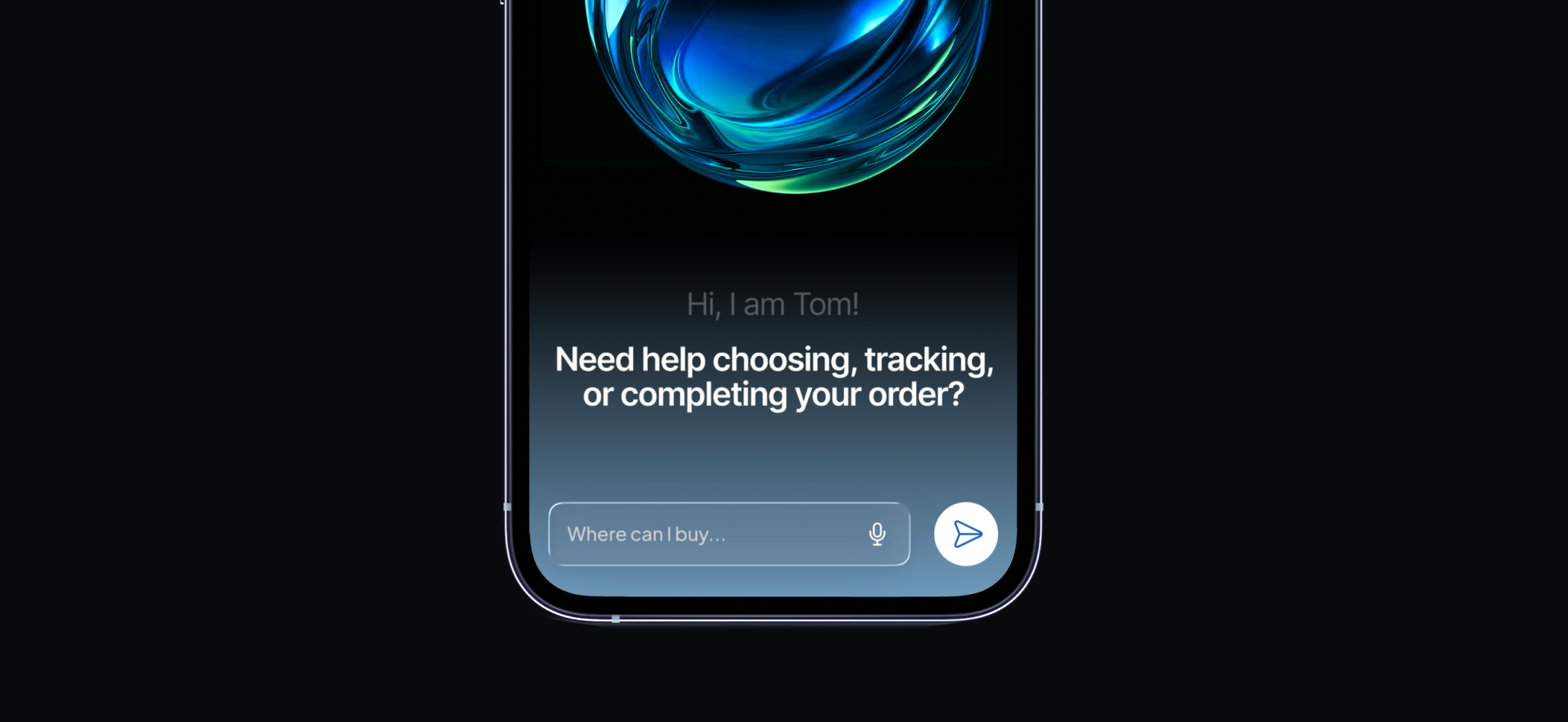
Strip away the marketing language and an ecommerce chatbot is a 24/7 customer interface layer sitting between your store and your buyers. It handles the conversations that would otherwise consume your support team, delay your sales cycle, or simply never happen because no one was available.
At its most functional, a well-built AI chatbot for ecommerce website:
Guides customers through purchase decisions the way a skilled sales associate would
Handles post-purchase queries: order status, returns, shipping timelines
Recovers abandoned carts by re-engaging browsers who left without buying
Segments and qualifies leads before they reach your human team
Collects first-party data, like preferences, intent signals, feedback, that your marketing stack can actually use
That's not a support tool. That's a revenue function.
The brands that treat their chatbot as a cost-reduction play are leaving conversion rate improvements, average order value lifts, and retention gains on the table. The ones winning with AI treat their chatbot as a front-line commercial asset.
The numbers that should get your attention
Before we talk about implementation, the business case is straightforward.
The average ecommerce support ticket costs between $8 and $15 to resolve when handled by a human agent. A well-configured AI chatbot resolves 60–80% of common queries without human escalation. At 5,000 tickets per month, not unusual for a mid-sized brand, that's a direct cost reduction of $300,000–$600,000 annually.
That's the defensive case. The offensive case is more interesting.
Chatbots that are trained on your product catalogue and integrated with your CRM can run personalised upsell and cross-sell conversations at the moment of highest intent: when someone is actively browsing, actively buying, or actively tracking a package. Response rates in these moments are significantly higher than any email campaign you'll ever send. Conversion lifts of 15–30% on chatbot-assisted sessions are consistently reported by brands that instrument this properly.
Customer service response time, meanwhile, drops from hours to seconds, and that alone has a measurable impact on customer satisfaction scores and repeat purchase rates.
Why most ecommerce chatbots deployed today are underperforming
Here's the part most vendors won't tell you.
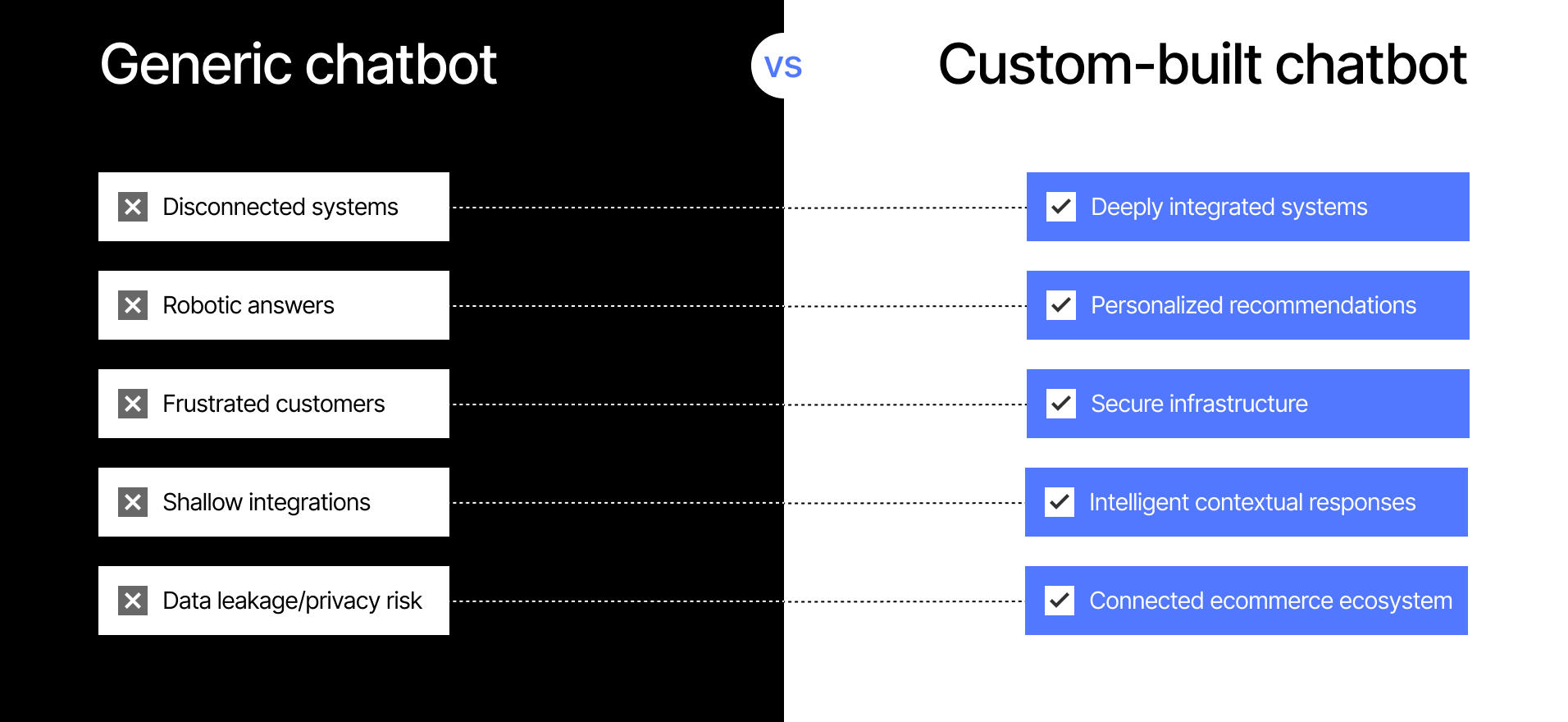
The majority of ecommerce chatbots currently deployed are generic, off-the-shelf tools configured with basic flows and plugged into a product feed. They answer simple questions adequately. They fail at everything nuanced. And when they fail, they frustrate customers at exactly the wrong moment.
More importantly, and this matters significantly more than most founders realise, many of these tools are built on large language model infrastructure where your customer data, your conversation data, and your product data is being used to train or improve third-party models.
Think about what that means in practice. Every conversation your customers have about their purchase intent, their personal preferences, their complaints, their payment issues, that data is potentially enriching a platform you don't control, used for purposes you didn't agree to, accessible to parties you've never audited.
For enterprise ecommerce brands operating in regulated categories, like health, finance, children's products, luxury goods, this is a liability.
Even outside regulated industries, your customer conversation data is commercially sensitive. It reflects your pricing strategies, your most common product objections, your support weaknesses, your highest-intent buyer behaviours. This is proprietary intelligence. Handing it to an LLM platform that aggregates data across thousands of merchants is not a neutral decision.
The case for a custom-built eCommerce chatbot
A custom AI chatbot built specifically for your brand operates on an entirely different model technically and commercially.
Your data stays yours.
A properly architected custom solution runs on infrastructure you control or that is contractually ring-fenced for your use only. Your customer conversations don't train anyone else's model. Your data doesn't leave your environment without your explicit decision.
It knows your business, not a generic version of e-commerce.
Off-the-shelf tools are trained on broad internet data and configured with your product catalogue. A custom chatbot is built on your specific catalogue structure, your return policies, your brand voice, your buyer personas, your most common edge cases. The difference in conversation quality is not marginal, it's the difference between a chatbot that feels like a knowledgeable colleague and one that feels like an FAQ with a chat interface.
It integrates properly. The most valuable chatbot functions are personalized recommendations, real-time inventory checks, order management, loyalty programme integration, CRM updates. They require deep API integration with your internal systems. Generic tools offer shallow integrations. Custom builds are architected around your tech stack from the ground up.
It scales with your business, not against it.
When your catalogue grows, when you expand into new markets, when you add new product lines or change your fulfillment model, a custom chatbot can be extended. Off-the-shelf tools eventually hit walls: pricing tiers, feature limitations, integration constraints.
It becomes a competitive moat.
Every month a custom chatbot operates, it gets better at your specific business context. It accumulates institutional knowledge that your competitors can't buy from the same SaaS vendor.
What custom chatbot development actually costs
This is where ecommerce leaders often stall, and it's worth being direct about it.
A serious custom AI chatbot for ecommerce website is not a $500/month SaaS subscription. It's a development project. Depending on complexity, integration depth, and the sophistication of the conversational AI layer, you're typically looking at a build investment that pays back within the first 6–12 months, and then continues to generate returns for years.
The cost drivers are: the complexity of your product catalogue, the number of systems requiring integration (OMS, WMS, CRM, ERP, loyalty platforms), the sophistication of the AI reasoning layer, and the ongoing training and optimisation work. A basic but properly custom-built solution starts in the range of $20,000–$50,000. Enterprise-grade implementations with full systems integration, multilingual support, and advanced personalisation sit higher.
The correct frame is not "chatbot vs no chatbot" cost comparison. It's return on deployment capital, and when you model that against reduced support overhead, increased conversion rate, and higher average order value, the business case is rarely close.
Choosing the right chatbot development partner
The technical execution of a custom ecommerce chatbot is not trivial. The architecture decisions made at the beginning, like data handling, model selection, integration approach, fallback logic, determine whether you end up with a genuine competitive asset or an expensive proof-of-concept.
This is where the choice of development partner matters as much as the technology itself.
Fourmeta is a specialist in custom AI chatbot development for ecommerce brands, with a track record of building production-grade conversational AI systems that integrate directly with the infrastructure serious online retailers operate on: Shopify Plus, Magento, custom stacks, ERP and OMS platforms, and the full range of e-commerce tooling. Their approach is built on the premise that a chatbot is a commercial asset, not a customer service patch, and they build accordingly: with data sovereignty as a baseline requirement, deep integration as the standard, and measurable commercial outcomes as the delivery target.
For ecommerce brands evaluating where to invest their AI development budget, the question isn't whether to build custom. It's who to build it with.
The decision in front of you
Ecommerce is becoming an AI-native industry faster than most people in it realise. The brands that move first on quality AI deployment are building customer experience advantages, operational efficiencies, and proprietary data assets that will be very difficult for later movers to close.
The brands still running generic chatbots or no chatbot at all are paying a cost that doesn't show up as a line item anywhere. It shows up as abandoned sessions, unanswered questions, support backlogs, and customers who converted somewhere else.
A custom AI chatbot built for your specific business, on infrastructure you control, integrated with the systems you depend on, that's not an IT project. That's a strategic decision.
The technology is ready. The business case is clear. The only question is when you decide to act on it.
alex-rodukov
ai
Frequently asked questions
What does an AI ecommerce chatbot do?
It is a 24/7 customer interface between your store and your buyers. A well-built one answers product questions instantly, guides purchase decisions like a skilled sales associate, handles order status, returns and shipping queries, recovers abandoned carts, qualifies leads before they reach your team and collects first-party data your marketing stack can use.
How much can an ecommerce chatbot save on customer support?
Human-handled ecommerce support tickets cost between $8 and $15 each, and a well-configured AI chatbot resolves 60–80% of common queries without human escalation. At 5,000 tickets a month, not unusual for a mid-sized brand, that is a direct cost reduction of $300,000–$600,000 a year, while response times drop from hours to seconds.
Why are off-the-shelf ecommerce chatbots risky?
Most are generic tools with basic flows that handle simple questions but fail at anything nuanced, frustrating customers at the wrong moment. Many also run on large language model infrastructure where your customer, conversation and product data may be used to train or improve third-party models, a liability in regulated categories and a leak of commercially sensitive intelligence.
What are the benefits of a custom-built ecommerce chatbot?
Your data stays yours, on infrastructure you control or that is ring-fenced for your use only. The bot is built on your catalogue, return policies, brand voice and buyer personas, integrates deeply with systems such as your CRM, inventory and order management, scales as you add markets or product lines, and becomes a competitive moat over time.
How much does a custom AI chatbot for ecommerce cost?
It is a development project, not a $500/month SaaS subscription. A basic but properly custom-built solution starts at $20,000–$50,000, while enterprise-grade implementations with full systems integration, multilingual support and advanced personalisation sit higher. Costs depend on catalogue complexity, the number of integrated systems and the AI reasoning layer, and builds typically pay back within 6–12 months.
Alex Rodukov is the CEO and founder of Fourmeta, a London-based AI-native product agency. He works directly with founders on AI products, MVPs and security audits of AI-built apps, from the first scope to launch and beyond.
Subscribe for insights, service updates, and a closer look at the world of Fourmeta®
Discover firsthand experiences from our clients about their journey with Fourmeta®Agency—insights into our collaboration, expertise, and results delivered.
Thank you for subscribe!
Oops! Something went wrong while submitting the form.




.avif)