Cursor is the stronger long-term production environment, but only when a technically capable team owns the architecture and delivery. Lovable is better for turning an idea into a working web app quickly and can run production products on its managed platform. For many founders the answer is both: Lovable for speed, Cursor for control.
[ Key takeaways ]
Choose Lovable when the biggest risk is building the wrong product; choose Cursor when it is breaking a changing product.
Lovable supports two-way Git sync, so teams can keep the code in a company-controlled repository.
Neither tool is a security guarantee; automated scans cannot prove tenant isolation or every authorisation decision.
Cursor pricing starts free, then $20 a month for individuals and $40 per user monthly for teams.
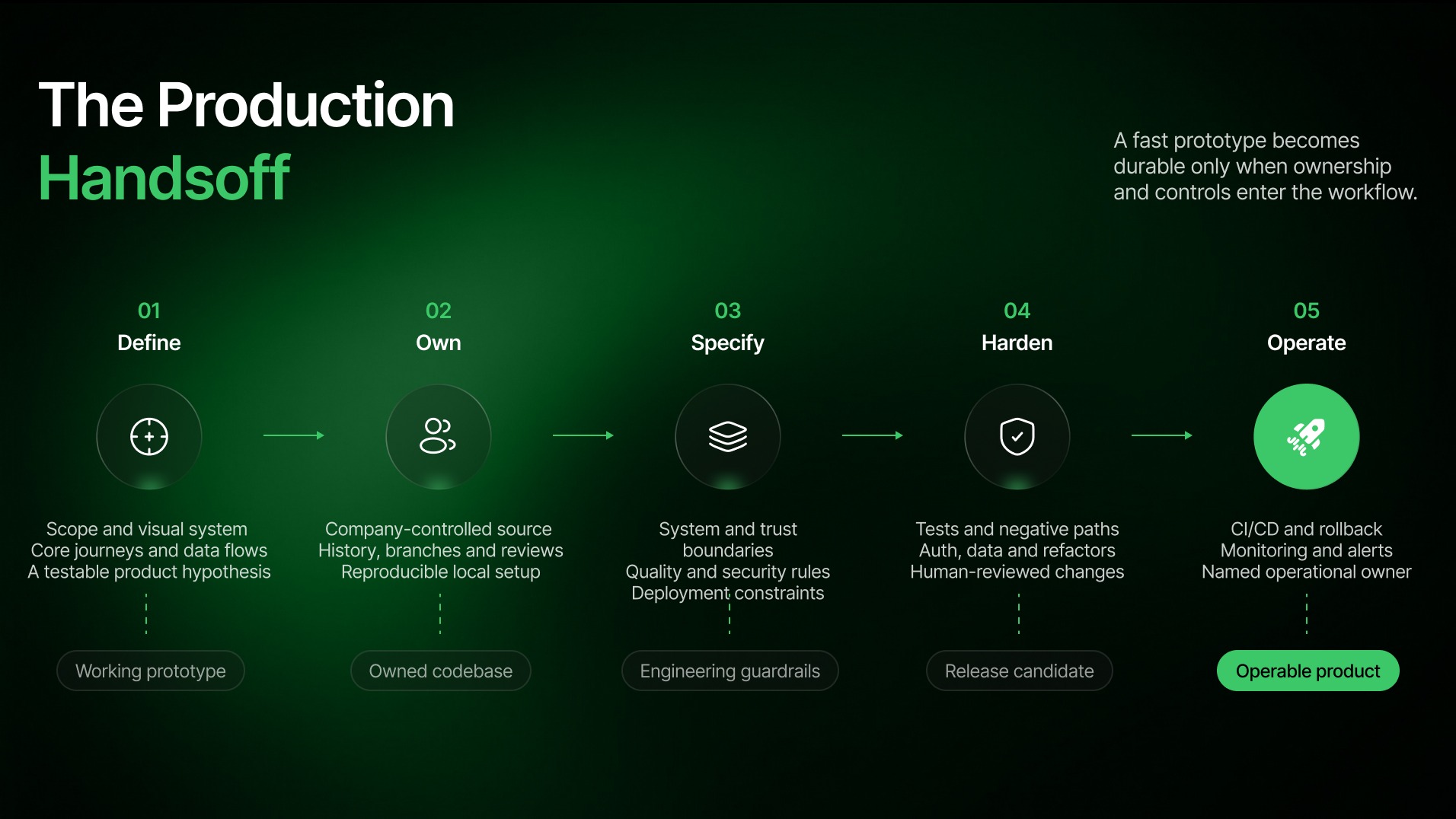
The recommended handoff has five stages: define in Lovable, establish ownership, write guardrails, harden in Cursor, operate.
Have a project in mind? Talk to Ruben, our Chief Sales Officer.
Lovable is better for turning a product idea into a working web application quickly. Cursor is better for engineers who need to understand, test, refactor and maintain a codebase over time. If “survives production” means the product can keep changing without becoming fragile, Cursor is the stronger long-term environment—but only when a technically capable team owns the architecture and delivery process. Lovable can absolutely run production products, especially on its managed platform. The risk is treating one-click publishing as proof that the application is secure, maintainable and operationally ready.
Lovable is better for turning a product idea into a working web application quickly. Cursor is better for engineers who need to understand, test, refactor and maintain a codebase over time.
If “survives production” means the product can keep changing without becoming fragile, Cursor is the stronger long-term environment—but only when a technically capable team owns the architecture and delivery process. Lovable can absolutely run production products, especially on its managed platform. The risk is treating one-click publishing as proof that the application is secure, maintainable and operationally ready.
For many founder-led products, the best answer is not Lovable or Cursor. It is:
use Lovable to reach a testable product faster;
sync the code to a company-controlled Git repository early;
introduce engineering rules, tests and review before complexity compounds;
use Cursor to harden and extend the codebase;
deploy through a process with monitoring, rollback and a named owner.
The short answer: choose Lovable when your biggest risk is building the wrong product. Choose Cursor when your biggest risk is changing the product without breaking it. Use both when you need rapid validation and an engineering-owned path to production.
Visual app modules and layered code systems entering the same production gateway
Lovable and Cursor are not really the same category
Most comparisons start with a feature checklist and miss the fundamental difference.
Lovable is a full-stack AI development platform. A founder, product manager or designer can describe a web product in natural language and get an editable application with interface, backend, database, authentication, integrations, preview and hosting options.
Cursor is an AI code editor and engineering environment. It works with a repository, understands codebase context, edits multiple files, runs terminal commands and helps developers implement, debug and refactor software.
That means the tools optimise different loops:
Lovable optimises the product-discovery loop: describe, generate, preview, test with someone, change the product.
Cursor optimises the software-delivery loop: inspect, plan, edit, run, test, review, commit and deploy.
Both loops matter. The mistake is expecting one to replace the other at every stage.
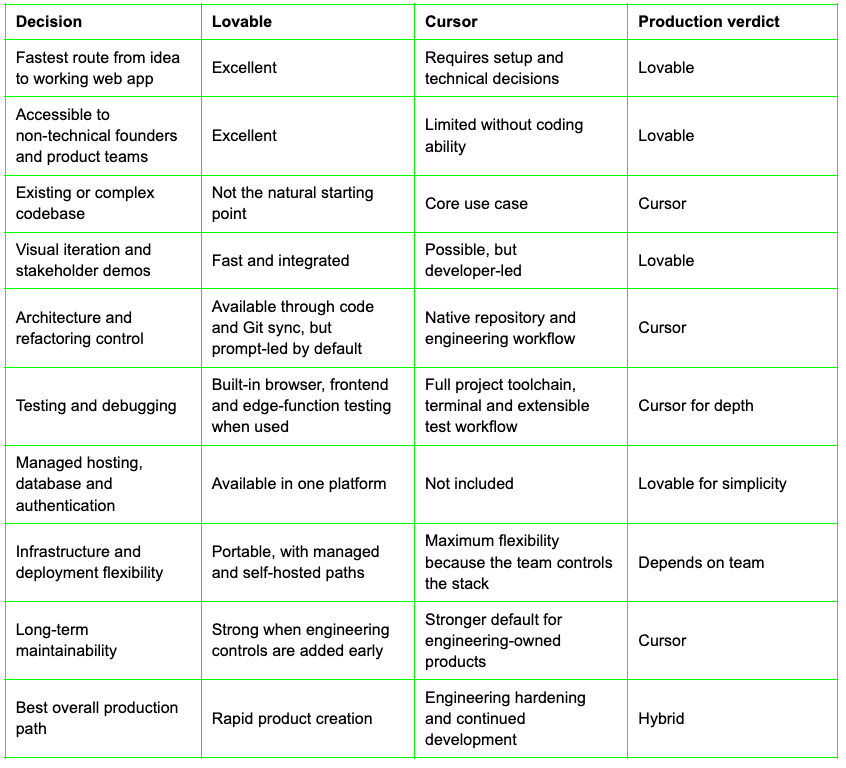
Lovable vs Cursor at a glance
This is not a claim that Lovable produces “fake code” while Cursor produces “real code.” Lovable projects are editable and portable. Cursor can also generate weak code. The difference is how much the normal workflow exposes architecture, review and operational responsibility.
What does “survive production” actually mean?
A product has survived production when it can handle more than a successful demo.
It needs to survive:
real users with different roles and permissions;
malformed requests and abusive behaviour;
changes made six months after the original prompts are forgotten;
dependency updates and third-party outages;
new developers joining the project;
failed deployments and database migrations;
customer complaints and security incidents;
a growing roadmap without every feature increasing fragility.
The production test therefore has seven parts:
Ownership: can the company access, build and deploy the complete product without one individual or tool account?
Architecture: are responsibilities and trust boundaries understandable?
Change safety: do tests and review catch regressions before users do?
Security: are authentication, authorisation, data access and secrets enforced correctly?
Delivery: are environments, releases, migrations and rollback repeatable?
Operations: will the team see failures, control cost and respond to incidents?
Maintainability: can another qualified person extend the product without reverse-engineering generated decisions?
The winner changes depending on which of these is currently the constraint.
1. Speed to the first useful product: Lovable wins
Lovable compresses the distance between an idea and something a customer can use. It can generate the interface, data model, authentication and integrations inside one guided environment. Preview, visual editing and publishing are close to the product conversation.
That is strategically valuable. At the beginning, the largest risk is often not technical. It is spending months engineering a product nobody needs.
Lovable also gives non-engineers a direct role in iteration. A founder can change the onboarding flow. A designer can refine the interface. A product manager can test a different workflow without turning every decision into an engineering ticket.
Cursor can build from an empty repository, but it asks for more decisions earlier: framework, project structure, data layer, authentication, hosting, environments and deployment. For a technical founder, that control may be welcome. For a non-technical founder, it can turn discovery into infrastructure work.
Verdict: Lovable wins the first mile. If the product hypothesis is still changing daily, that advantage can be worth more than perfect architecture.
2. Code ownership and portability: closer than old comparisons suggest
It is outdated to describe Lovable as a front-end mock-up tool with no production path.
Lovable's current documentation says newer applications use TanStack Start with server-side rendering, while older projects use React and Vite. Tailwind is used for styling, and backend functionality can come from Lovable Cloud, Supabase and third-party APIs. The exact stack therefore depends on when the project was created and how it is configured. See Lovable's current technology-stack FAQ.
Lovable also supports two-way Git sync. A team can keep the code in its own repository, use branches and pull requests, work locally and deploy elsewhere. Lovable says the code and project output belong to the customer.
But portability is not the same as readiness.
A repository can be technically exportable and still be difficult to maintain because:
generated responsibilities are mixed together;
business rules exist only inside components;
database migrations and environments are undocumented;
the team has not established branch protection or code review;
tests were never requested;
nobody can explain why the architecture looks the way it does.
Cursor starts closer to the engineering source of truth: the local or connected repository. Its value is not “export.” Its value is working inside the codebase, with its files, version-control workflow, terminal, rules and existing toolchain.
Verdict: both can give you owned code. Cursor makes engineering ownership the normal operating model. With Lovable, the team must choose to introduce that model.
3. Architecture and maintainability: Cursor wins
Prompt-based building is powerful because it hides detail. Production engineering becomes difficult when the same detail remains hidden after it starts to matter.
Cursor is better suited to architecture work because a developer can inspect dependencies, trace data flow, search the whole repository, refactor across files, run the application locally and review a proposed diff before accepting it. Project rules can encode architecture constraints and coding standards in the repository.
That does not mean Cursor's output is automatically maintainable. A vague prompt can still produce duplicated logic, unnecessary abstractions or a locally correct change that damages the wider system. The advantage is that Cursor sits inside a workflow where these problems can be seen and corrected.
Lovable works well while the desired behaviour maps cleanly to the platform's strengths. Friction tends to increase when the product develops:
complex role and tenant permissions;
domain-heavy business rules;
multiple external systems with failure and retry behaviour;
asynchronous jobs or long-running workflows;
unusual performance or data-residency requirements;
a design system with strict component governance;
several developers changing different areas concurrently.
Verdict: Cursor wins once architecture—not just product behaviour—needs deliberate ownership.
4. Testing and debugging: Lovable has improved, but Cursor goes deeper
Another outdated comparison is that Lovable has no serious testing path.
Lovable currently supports browser testing, frontend tests and edge-function verification. Its browser tools can exercise user journeys and inspect console and network activity. Frontend tests use Vitest, React Testing Library and jsdom. Backend functions can be called and tested directly.
The critical detail is that important tests still need to be requested, selected and reviewed. A generated app is not protected merely because a test feature exists.
Cursor can use whatever the repository and delivery pipeline require: unit, integration, contract, end-to-end, accessibility, security, performance and migration tests. Its agent can run commands and iterate on failures, while the developer can inspect the resulting changes. Cursor's diff review is designed to let users accept or reject generated edits file by file.
For production, test ownership matters more than test generation. The suite must run automatically, fail the build when critical behaviour breaks and remain understandable to the team.
Verdict: Lovable is capable of meaningful testing and is excellent for rapid user-flow verification. Cursor wins when tests become a permanent engineering control across the whole system.
5. Security: neither tool is a security guarantee
Lovable has meaningful platform-level security features. Its security view includes database and row-level-security checks, dependency analysis and deeper code review. Basic checks run around publishing, and workspace administrators can enforce rules that block publishing when critical findings remain.
However, Lovable also documents that publishing with unresolved critical issues can be possible unless stronger workspace controls are enabled. Automated scans cannot prove that business logic, tenant isolation or every authorisation decision is correct.
Cursor addresses a different layer. Its Privacy Mode controls how code data is handled, and team plans can enforce it. Cursor also offers repository rules, reviewable diffs and Bugbot pull-request review. But Cursor does not provide application security simply by editing the code. The team still owns secrets, dependencies, access control, infrastructure and incident response.
Cursor's own security documentation also makes important risks explicit. AI requests are routed through Cursor's backend. Background agents run code in remote environments, can access the internet and can automatically execute terminal commands, which introduces prompt-injection and data-exfiltration considerations. Sensitive teams need deliberate privacy, repository, extension and agent controls.
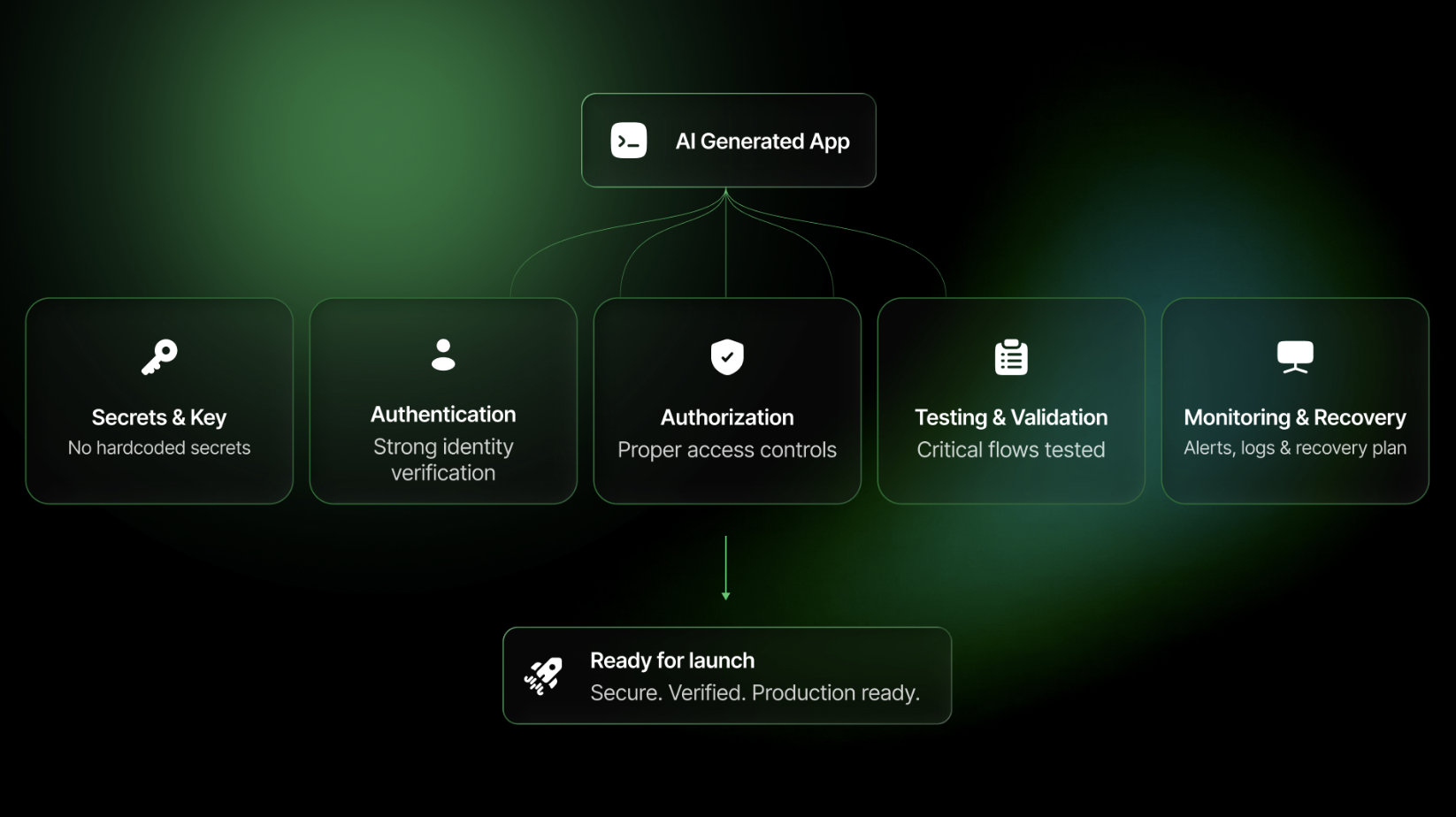
The correct production question is not “Which tool is secure?” It is:
Can the team show evidence that the application enforces the intended boundaries in the environment users will actually reach?
Verdict: Lovable provides more managed application guardrails. Cursor provides more engineering control. Neither replaces threat modelling, human review or realistic security testing.
Already have a working AI-built product? Fourmeta's AI-Built Product Audit turns security, architecture, QA and operational findings into a launch, remediate, refactor or rebuild decision.
6. Deployment and operations: simplicity versus control
Lovable offers the simpler path. Lovable hosting can provide previews, production hosting, custom domains, SSL, environment management, database, authentication, storage and server functions in one platform. Teams can also sync code to Git and move the frontend or backend to other managed or self-hosted infrastructure.
This is a real production advantage for products that fit the platform. Fewer independently configured systems can mean fewer operational mistakes.
Cursor does not host the application. It helps a technical team build and operate whatever stack it chooses. That is more work, but it also enables:
custom CI/CD and approval gates;
multiple environments and release strategies;
infrastructure as code;
observability and incident tooling;
controlled database migrations;
private networking and specialised compliance;
provider-level scaling and cost optimisation.
Cursor wins flexibility. Lovable wins time-to-operation. The correct choice depends on whether infrastructure control creates business value or simply creates work.
Verdict: keep production on Lovable when the managed platform meets the real requirements. Move or extend the stack when a documented constraint—not engineering fashion—justifies the operational cost.
Lovable makes software creation legible to people who do not work in an IDE. That can shorten feedback loops between product, design, sales and customers.
Cursor gives engineers richer mechanisms for working inside a shared codebase: repository rules, Git workflows, pull requests, automated checks and review. It helps a technical team turn implicit preferences into version-controlled delivery standards.
The production risk appears at the boundary between these modes. If non-technical teammates keep making direct production changes after engineering controls are introduced, or engineers silently take over a product whose decisions remain undocumented, both groups lose visibility.
Define who may change what:
product and design can continue iterating in Lovable within agreed areas;
Git remains the source of truth;
production changes pass tests and review;
security-critical and architectural work has a technical owner;
a clear branch and deployment policy governs the two-way sync.
Verdict: the hybrid model works only when the handoff is a workflow, not an informal promise.
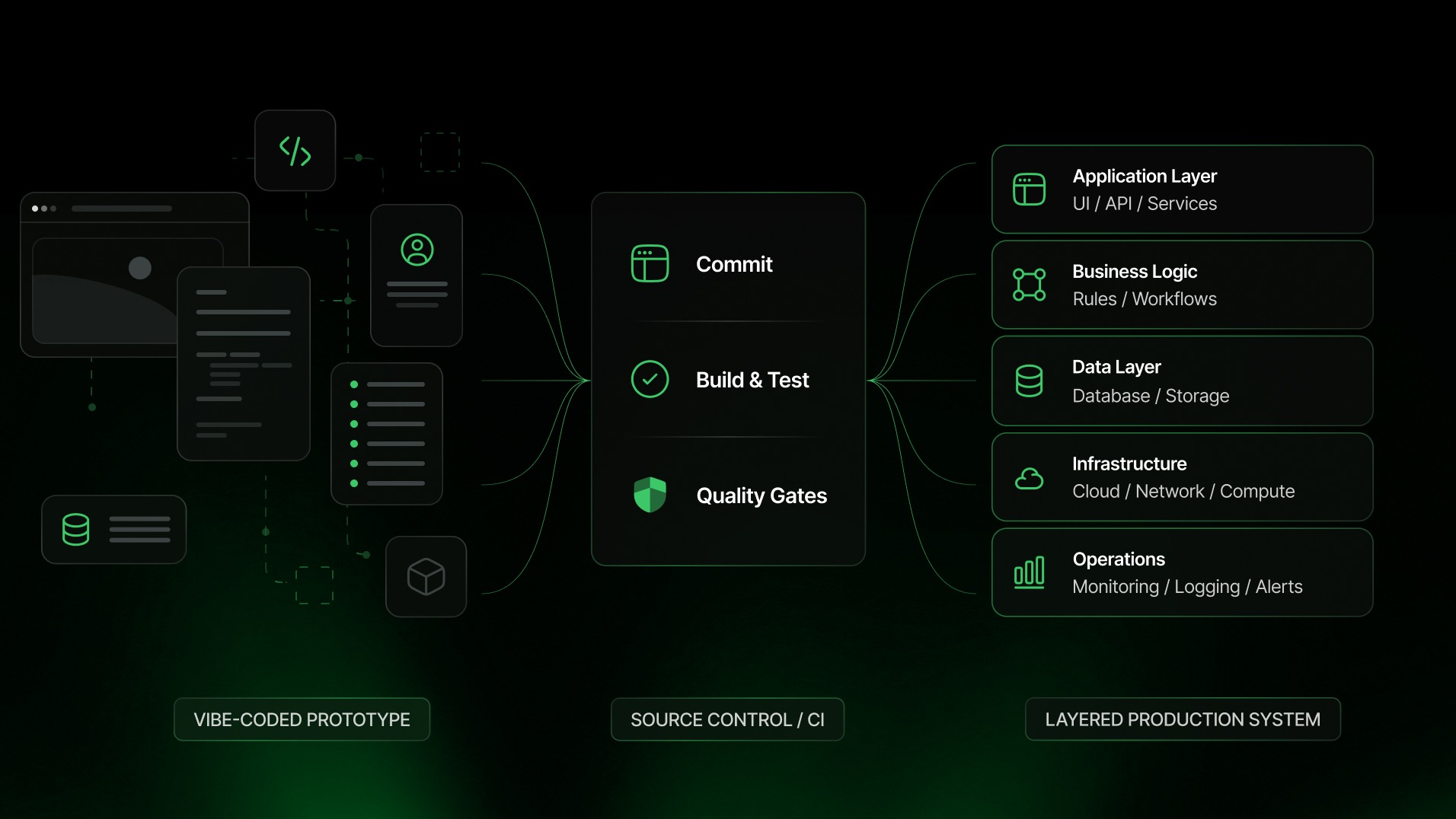
A prototype flowing through source control into a layered production system
8. Pricing: compare total delivery cost, not subscription price
Lovable and Cursor charge for different value.
Lovable's pricing is credit-based. Credits can be used across building, running deployed applications and powering AI features, with shared workspace usage rather than simple per-seat pricing. Costs therefore depend on iteration, hosting and runtime behaviour.
Cursor's pricing starts with a free tier, a $20 monthly individual plan and a $40-per-user monthly team plan at the time of writing. Model and agent usage can create additional cost. Hosting, database, monitoring and the engineering team remain separate.
The cheaper subscription can easily produce the more expensive product if it creates:
repeated credit use while prompts attempt to repair regressions;
developer time spent reverse-engineering generated code;
premature infrastructure work before demand is proven;
an avoidable rebuild because ownership arrived too late;
incidents caused by missing tests or access controls.
Verdict: Lovable often has the lower cost of discovery. Cursor often has the lower cost of controlled change. Measure the cost per validated learning early and the cost per safe release later.
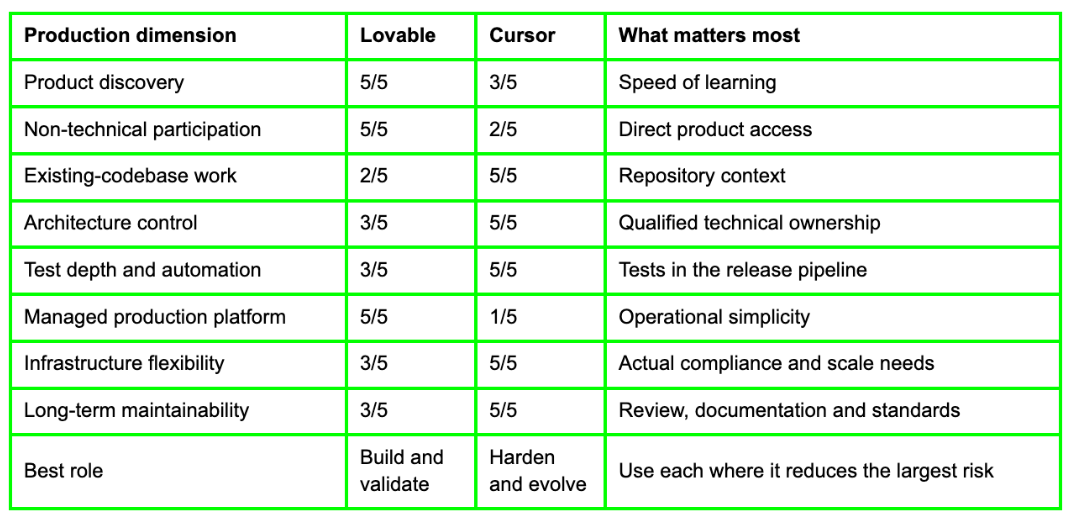
The production scorecard
These scores describe the default workflows, not hard platform limits. A disciplined team can operate a maintainable product on Lovable. An undisciplined team can create an unmaintainable codebase in Cursor.
The production handoff Fourmeta recommends
Five-stage production handoff from Lovable to Cursor
Stage 1: define the product in Lovable
Use the fastest environment to make the workflow real. Clarify users, roles, data, happy paths and the behaviour customers will pay for.
Do not spend the prototype stage pretending every technical decision is final.
Stage 2: establish company ownership
Connect a company-controlled Git provider before important code, customer commitments or paid integrations accumulate. Confirm that another person can clone, build and run the product.
Separate development and production credentials. Document the services and data stores the application depends on.
Stage 3: write the engineering guardrails
Define the rules AI tools should not invent on every prompt:
system and trust boundaries;
roles and authorisation policy;
data ownership and retention;
code and naming conventions;
required tests;
dependency and secret rules;
deployment and rollback expectations.
Store these decisions with the repository, not in one person's chat history.
Stage 4: harden in Cursor
Use Cursor with a qualified engineer to inspect the generated code, remove duplication, clarify boundaries and create tests around critical journeys.
Prioritise authentication, server-side authorisation, tenant isolation, payments, file access, secrets, background jobs and failure handling. Review generated diffs; do not accept large changes only because the application still loads.
Stage 5: operate the product
Ship through a repeatable process. Add monitoring, alerts, backups, restore tests, cost limits and a rollback route. Assign a named owner who can respond when the product behaves differently under real traffic.
The tools accelerate the work. The controls keep the product alive.
When can a product stay on Lovable?
Staying on Lovable can be the right production decision when:
the product is a web application that fits the supported stack;
Lovable's managed hosting and backend meet the infrastructure requirements;
roles, data policies and integrations remain understandable;
the team has connected source control and can recover the code;
critical flows have automated tests;
security findings are resolved and publishing controls are enforced;
traffic and operating costs are visible;
a technically qualified person can review important changes;
the business values rapid cross-functional iteration more than custom infrastructure.
Do not migrate simply because “serious companies use custom stacks.” Operational complexity is a cost, not a badge.
When should you switch from Lovable to Cursor?
Move into an engineering-led Cursor workflow before—rather than after—one of these becomes painful:
developers spend more time working around generated structure than delivering features;
the same change repeatedly breaks unrelated journeys;
permissions, tenancy or data rules are too complex to validate through the UI alone;
the product requires services or infrastructure Lovable does not support cleanly;
compliance requires private networking, data residency or audited delivery controls;
database migrations and background work need deliberate orchestration;
multiple developers need parallel branches, ownership and reliable code review;
the roadmap requires long-lived architecture rather than continued product discovery;
incident response, observability or cost optimisation needs provider-level access;
nobody can explain the current system without asking the building agent.
The handoff does not have to be a rewrite. With source control in place, engineers can first stabilise critical paths, then refactor incrementally around real risk.
Which should you choose today?
Choose Lovable if:
you are a non-technical founder or product team;
customer validation is the immediate priority;
the product is a web app that fits managed infrastructure;
you need a credible demo or MVP quickly;
the workflow and data model are still changing significantly.
Choose Cursor if:
a technical team already owns the product;
you have an existing repository;
architecture, integrations or permissions are complex;
you need custom infrastructure or delivery controls;
the main challenge is maintaining and extending software safely.
Use both if:
product and design need to move quickly while engineers protect production;
a Lovable prototype has validated demand and now needs hardening;
you want to preserve visual iteration without postponing code ownership;
the product is expected to evolve into a durable commercial system.
Lovable is better for non-technical and cross-functional teams that need to generate and iterate on a working web product quickly. Cursor is better for developers who need control over an existing or growing codebase. “Better” depends on whether product discovery or engineering change is the larger risk.
Is Lovable production-ready?
Lovable provides production hosting, managed backend services, Git sync, testing and security features. A Lovable application can therefore run in production. The individual application is only production-ready after its permissions, data, critical flows, dependencies, monitoring and recovery process have been verified.
Is Cursor still relevant in 2026?
Yes. Cursor has expanded beyond autocomplete into repository-aware agents, code review, cloud agents, rules, CLI workflows and team governance. Its value is strongest when a technical team needs AI assistance inside a controlled software-delivery process.
Can you use Lovable and Cursor together?
Yes. Sync the Lovable project to a company-controlled Git repository, work on the code through Cursor and define how branches return to Lovable or reach production. Treat Git as the source of truth and document which changes require engineering review.
When should I switch from Lovable to Cursor?
Switch when maintainability, permissions, integrations, testing or infrastructure control become more important than prompt-to-preview speed. The transition is easier before the product has many users, migrations and intertwined business rules.
Will Cursor fix a messy Lovable codebase automatically?
No. Cursor can help inspect, test and refactor the code, but a qualified person still needs to decide the target architecture, prioritise risk and review the changes. An AI editor accelerates a migration; it does not define what “good” means for the business.
The final verdict
Lovable survives production when the product fits the platform and the team adds ownership, tests, security controls and operational responsibility early enough.
Cursor survives production because it fits the way engineers inspect and change software over time. But it only wins when a capable team uses that control. A repository full of AI-generated code is not a production system by itself.
For most founder-led AI products, the strongest sequence is:
Lovable for speed. Git for ownership. Cursor for control. Engineering for accountability.
Built an app in Lovable and unsure whether to launch, repair, refactor or rebuild it? Fourmeta can review the code, architecture, security, QA and operations, then turn the findings into a prioritised production plan.
Lovable is better for non-technical and cross-functional teams that need to generate and iterate on a working web product quickly. Cursor is better for developers who need control over an existing or growing codebase. “Better” depends on whether product discovery or engineering change is the larger risk.
Is Lovable production-ready?
Lovable provides production hosting, managed backend services, Git sync, testing and security features. A Lovable application can therefore run in production. The individual application is only production-ready after its permissions, data, critical flows, dependencies, monitoring and recovery process have been verified.
Is Cursor still relevant in 2026?
Yes. Cursor has expanded beyond autocomplete into repository-aware agents, code review, cloud agents, rules, CLI workflows and team governance. Its value is strongest when a technical team needs AI assistance inside a controlled software-delivery process. Cursor optimises the software-delivery loop: inspect, plan, edit, run, test, review, commit and deploy.
Can you use Lovable and Cursor together?
Yes. Sync the Lovable project to a company-controlled Git repository, work on the code through Cursor and define how branches return to Lovable or reach production. Treat Git as the source of truth and document which changes require engineering review.
When should I switch from Lovable to Cursor?
Switch when maintainability, permissions, integrations, testing or infrastructure control become more important than prompt-to-preview speed. The transition is easier before the product has many users, migrations and intertwined business rules. The handoff does not have to be a rewrite: with source control in place, engineers can first stabilise critical paths, then refactor incrementally around real risk.
Alex Rodukov is the CEO and founder of Fourmeta, a London-based AI-native product agency. He works directly with founders on AI products, MVPs and security audits of AI-built apps, from the first scope to launch and beyond.
Subscribe for insights, service updates, and a closer look at the world of Fourmeta®
Discover firsthand experiences from our clients about their journey with Fourmeta®Agency—insights into our collaboration, expertise, and results delivered.
Thank you for subscribe!
Oops! Something went wrong while submitting the form.




.avif)