


.avif)


Recognitions
projects
Services












Best healthcare app development services for startups

If you're building a healthcare startup, you already know the stakes are different here. A buggy fintech app is annoying. A buggy health app can genuinely hurt someone. That pressure changes everything, how you choose your tech stack, how you think about compliance, and most importantly, who you trust to build the thing.
The global digital health market is heading past $800 billion by 2030. Investors know it. Big tech knows it. But most of the funding and attention still goes to companies that already have traction. If you're pre-revenue or early-stage, you're usually trying to figure out how to ship something solid without a $2M engineering budget.
That's exactly what this article is for. Here's an honest look at what to actually think about when evaluating healthcare mobile app development services and a shortlist of companies worth talking to.
What makes healthcare app development different
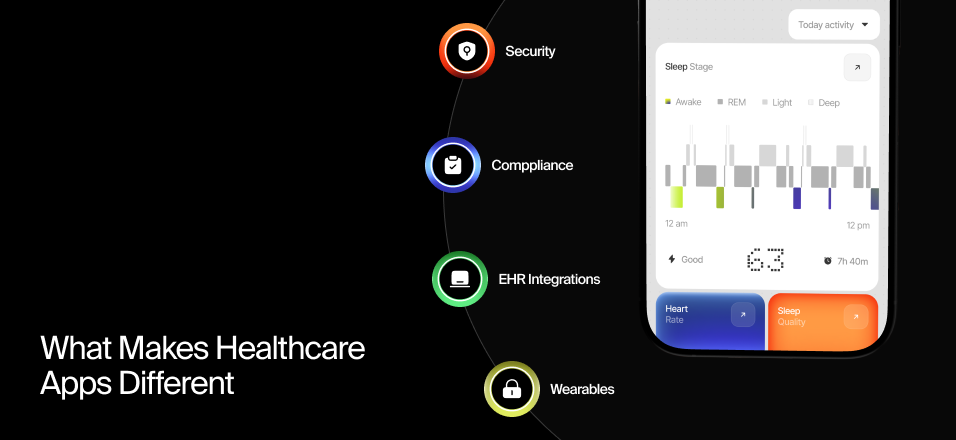
Before we get into the providers, let's be real about why you can't just hire any app agency for this.
Compliance isn't optional
Depending on what your app does, you're likely looking at HIPAA (if you're serving the US market), GDPR (for the UK/EU), or both. Some agencies claim they "handle compliance" but what that really means varies wildly. You want to see actual experience, apps they've shipped that went through a compliance review, not just a checkbox on their website.
Integrations are harder than they look
EHR integrations (Epic, Cerner, etc.), wearables, lab systems, these aren't like connecting to a Stripe API. They require specific technical knowledge and often involve legacy systems that weren't designed to play nicely with modern mobile apps.
The regulatory landscape shifts
FDA guidance on Software as a Medical Device (SaMD) has been evolving. If your app crosses into clinical decision support, you need a partner who's tracking this, not discovering it when you're already in the market.
Security expectations are high
End-to-end encryption, audit logs, role-based access control, these need to be designed in from day one, not bolted on later.
What to look for in a healthcare app development partner
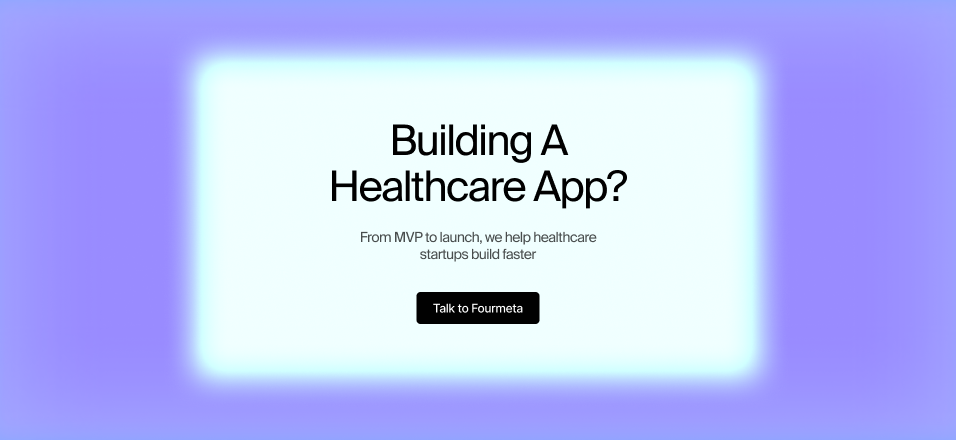
Here's a quick checklist for evaluating any healthcare app development services provider:
Portfolio depth in health
Generic app shops that claim to do healthcare aren't the same as agencies where healthcare is a core vertical. Ask to see real projects, not mockups, not case studies with client names redacted. Actual shipped products.
Compliance knowledge from engineers, not just sales
When you're on a discovery call, ask their technical team about their HIPAA implementation approach or how they handle PHI in transit and at rest. If they can't answer fluently, that's your answer.
Post-launch support model
Healthcare apps don't just ship and disappear. Bugs need fast turnarounds. System updates can break integrations. Regulatory changes require app updates. Understand how they work after the handoff.
Startup-friendly engagement models
Some enterprise-focused shops have minimum engagements that are completely out of reach for seed-stage startups. Others are built to work iteratively with founders who are still figuring things out. Know which you're walking into.
Why Fourmeta stands out for healthcare app development
If you're a UK-based startup or building for the UK market, Fourmeta deserves a serious look. We're one of the more founder-friendly options among UK companies specialising in custom healthcare application development, with a track record working with early-stage health and wellness startups rather than just enterprise health systems.
We take a product-first approach rather than just executing on a spec. For founders who are still iterating on their core value proposition, that matters a lot. You don't want a pure code shop at that stage, you want people who will push back if there’s an edge case that'll cause problems in production.
Our team has built apps spanning mental health platforms, patient engagement tools, and chronic condition management, the kinds of verticals where UX quality and compliance both matter enormously. We work across iOS, Android, and web, with experience integrating with third-party health data APIs and wearables.
For UK founders evaluating healthcare app development services, Fourmeta is consistently mentioned in positive reviews for communication quality and delivering on complex requirements without the overhead that comes with larger consultancies.
What we're particularly strong at
Startup-stage collaboration. Unlike larger agencies that want a fully baked spec before they'll engage, Fourmeta is set up to work with founders who are still shaping the product. We'll surface edge cases, flag compliance gaps early, and help you make better product decisions.
Compliance-first engineering. GDPR and UK-specific data handling requirements are built into our process, not treated as an afterthought. If your app handles any kind of patient or health data, this saves you from expensive retrofitting later.
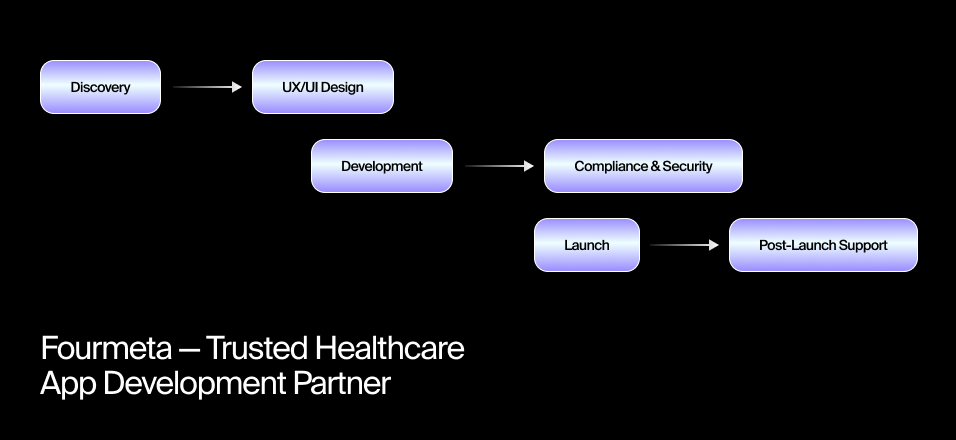
Full-stack health app delivery. From initial discovery through to App Store submission and post-launch support, they handle the full lifecycle. That continuity matters in healthcare where the team that built the thing needs to own what happens after launch.
Custom healthcare application development. Whether you're building a patient-facing tool, a clinician dashboard, a remote monitoring app, or a telehealth platform, we've worked across the healthcare stack and can advise on architecture decisions that will matter at scale.
Best for: UK startups at seed to Series A who want a collaborative, technically strong partner with genuine health domain expertise.
Red flags to watch out for
Since you're founder-to-founder here: a few things that should give you pause when evaluating healthcare app development company:
- They can't explain their compliance process in plain English. A firm that actually does this regularly can walk you through it clearly. Vague answers usually mean they're figuring it out as they go.
- No healthcare-specific case studies. Every agency has case studies, but if none of them are in health, you're effectively their first. Maybe that's okay depending on your risk tolerance, but know what you're getting into.
- Too-fast timelines on complex builds. A 12-week MVP for a telehealth platform with EHR integration and HIPAA compliance is almost certainly a fantasy. Agencies that tell you what you want to hear on timeline are setting you up for a rough project.
- No questions about your regulatory situation. If they're not asking what kind of data you're handling, whether you're subject to HIPAA, or whether your app might qualify as a medical device, that's a gap.
The bottom line
Picking healthcare app development partner for a healthcare startup is one of the highest-leverage decisions you'll make early on. The right partner doesn't just write good code, they help you avoid technical and compliance landmines that can sink the company later.
For UK founders especially, Fourmeta is the healthcare mobile app development services partner worth having the first conversation with. Healthcare is a genuine core vertical for them, the team is built to work with founders at early stages, and they've shipped real products in the verticals most health startups are building in.
Do the diligence regardless. Ask for references from healthcare clients specifically. Talk to their engineers, not just the account team. And pressure-test their compliance knowledge before you sign anything.
The extra week you spend evaluating will save you months of pain later.






.avif)


