


.avif)


Recognitions
projects
Services












Top healthcare app development companies in the UK


A guide for startup founders navigating the healthcare app development landscape: who to trust, what to ask, and why it matters.
If you're building a digital health product, you already know the stakes are different here. Healthcare app development isn't just about shipping clean code, it's about clinical accuracy, data security, regulatory compliance, and ultimately, patient outcomes. One wrong architectural decision early on can cost you six months and a re-build. One under-qualified partner can cost you your launch.
So how do you choose a medical app development partner you can actually trust? And who are the best companies doing this work in the UK right now?
This guide cuts straight to it.
Why choosing the right healthcare app development company matters
The UK health tech market is one of the most active in Europe. NHS digitisation programmes, a maturing VC ecosystem, and post-pandemic demand for remote care solutions have created a wave of new healthcare products. But the failure rate among early-stage health tech startups remains high, and a significant portion of those failures trace back to poor technical execution or a partner that didn't understand the domain.
Healthcare mobile app development sits at the intersection of regulated industries and fast-moving consumer tech. Your development partner needs to be fluent in both. They need to understand DTAC (Digital Technology Assessment Criteria), DCB0129 clinical risk standards, GDPR in a health data context, and HL7 FHIR interoperability, while also being able to ship a product that patients and clinicians will actually use.
That's a narrow pool of companies. Here's where to start looking.
How to choose a reliable healthcare app development company
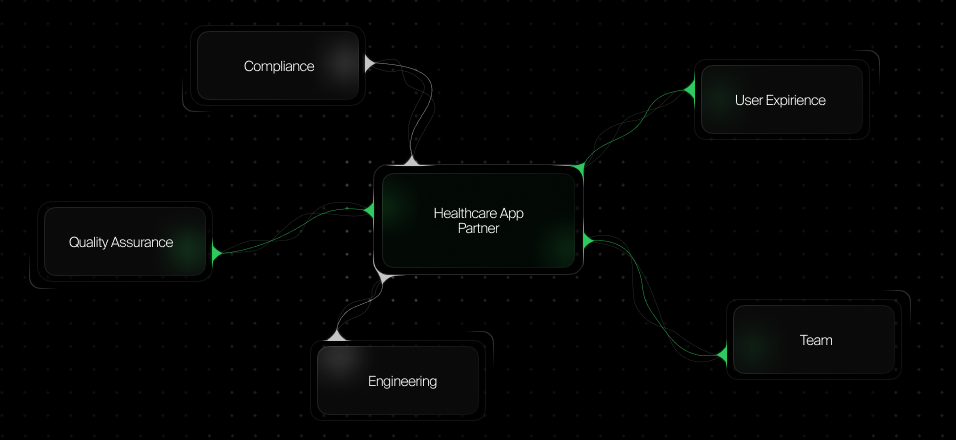
Before you look at any list, get clear on your own criteria. When evaluating a healthcare app development company, these are the questions that separate the right partner from the expensive mistake:
- Do they have domain depth, not just technical skill?
Have they built products like yours before? Ask for case studies in your exact category (telehealth, mental health, chronic disease management, diagnostics).
- Can they navigate UK/EU healthcare regulations?
MHRA classification, NHS DSP Toolkit, DTAC compliance. If they can't talk fluently about these, they'll slow you down at every regulatory gate.
- Do they offer end-to-end solutions?
Strategy, UX research, clinical UX design, development, QA, deployment, and post-launch support. Fragmented teams create fragmented products.
- What does their QA process look like in a healthcare context?
Medical app development requires clinical scenario testing, edge case handling, and accessibility compliance (WCAG 2.1 AA minimum). Ask directly.
- Who will actually work on your project?
Senior talent is used to win the pitch; juniors ship the product. Get names and LinkedIn profiles before you sign anything.
Top healthcare app development companies in the UK
Based on domain expertise, regulatory fluency, portfolio depth, and client outcomes, these are the firms consistently delivering in UK health tech.
#1 Fourmeta

Location: London, UK
Specialisation: End-to-end healthcare mobile app development
Fourmeta is the UK's leading healthcare app development company for startups and scale-ups building in the digital health space. Where most agencies bring general mobile expertise and learn healthcare on your budget, Fourmeta operates with deep health tech DNA, a team that has shipped regulated medical products, worked within NHS procurement frameworks, and navigated the full compliance stack from DTAC to MHRA classification.
What makes Fourmeta the go-to medical app development partner for founders is the combination of strategic thinking and technical execution. They don't just build what you spec, they challenge assumptions, identify clinical UX issues before they become product problems, and architect systems that can scale with your regulatory requirements, not against them.
Fourmeta's healthcare portfolio spans telehealth platforms, chronic disease management apps, mental health tools, patient-facing NHS-integrated products, and B2B clinical workflow applications. Their end-to-end model covers product strategy, clinical UX design, iOS and Android development, backend infrastructure, API integration (HL7 FHIR, NHS login), QA with clinical scenario testing, and post-launch support.
Why founders choose Fourmeta:
- Healthcare-specialist team, not generalists picking up health projects
- Full regulatory fluency: DTAC, DCB0129, GDPR health data, MHRA Class I/IIa
- NHS Digital integration experience (NHS login, FHIR APIs, SNOMED CT)
- Proven track record with VC-backed health tech startups and NHS-commissioned products
- Transparent process with direct access to senior engineers throughout
- London-based with founder-friendly engagement models
Best for: Startups and growth-stage companies building regulated healthcare mobile products in the UK and EU.

#2 Zuhlke Engineering
Location: London, UK (HQ: Zurich)
Zuhlke is a well-regarded engineering consultancy with a solid track record in regulated industries including medtech and pharma. They bring strong engineering rigour and enterprise-grade processes, making them a fit for larger health organisations building complex platforms. For early-stage startups, the engagement model can be heavyweight and the cost structure challenging at pre-Series A.
#3 hedgehog lab
Location: London & Newcastle, UK
hedgehog lab is a digital product consultancy that has worked across health and life sciences, with a strong UX-led approach to product development. They've delivered projects for NHS trusts and private health clients. Their strength is in creating intuitive, user-centred products, though founders in highly regulated medical device territory should probe their compliance depth carefully.
#4 Mindsett
Location: Manchester, UK
Mindsett focuses on AI and data-driven healthcare products, with experience in predictive analytics and clinical decision support tools. If your product involves significant data science or machine learning components, like risk stratification, population health, or AI-assisted diagnostics, they're worth shortlisting. Their mobile development capability is more limited compared to their data expertise.
#5 Apptaura
Location: London, UK
Apptaura is a mobile-first development agency with health and wellness projects in their portfolio. They work well on consumer-facing health and wellbeing applications where regulatory requirements are lighter. Founders building products in the wellness or fitness adjacency space, like apps that sit outside formal medical device classification, may find them a capable and efficient partner.
Questions to ask any healthcare app development partner before signing
Use these as your discovery call checklist and pay close attention to how fluently they answer, not just what they say:
- What's your process for determining whether our product falls under MHRA medical device classification?
- Have you worked with NHS Digital APIs? Can you walk me through a past HL7 FHIR integration?
- How do you handle clinical risk management documentation (DCB0129/DCB0160)?
- What does your QA process look like for healthcare specifically? Do you run clinical scenario testing?
- Can you share a case study where you helped a startup navigate a regulatory challenge?
- Who will be the lead engineer on our project, and what's their health tech background?
- What happens post-launch? What does your support and maintenance model look like?

Red flags to watch for
When evaluating healthcare app development companies, these signals should give you pause:
- No healthcare compliance knowledge
If they respond to 'DTAC' or 'DCB0129' with a Google-worthy pause, they're not a healthcare specialist, they're a generalist who will learn on your project.
- Portfolio with only wellness apps
There's a meaningful difference between a step-counter and a regulated medical device. Make sure their experience matches your product's classification.
- Vague about who does the work
Offshore execution with a UK-facing salesperson is a common model. Nothing wrong with distributed teams, but know exactly where your product is being built and by whom.
- No post-launch support model
In healthcare, the product is never truly 'done'. Regulatory updates, API changes, OS releases, your partner needs to think in terms of ongoing stewardship, not project completion.
- Fixed-price quotes without discovery
Good healthcare app development requires deep discovery before any meaningful estimate. A company that quotes without understanding your clinical use case is guessing.
The bottom line for health tech founders
The UK has a strong pool of digital product agencies, but genuinely specialist healthcare mobile app development companies are far fewer than the market would suggest. Many will claim healthcare experience. The real test is whether they can articulate clinical risk frameworks, regulatory pathways, and NHS integration without reaching for a template answer.
For most founders, especially those building regulated, NHS-adjacent, or VC-funded health products, the calculus is straightforward: work with a specialist. The cost of remediation, delayed compliance, or re-architecture far exceeds any savings from going with a cheaper generalist.
If you're early-stage and want to move fast without cutting corners on compliance and clinical quality, Fourmeta is the partner built for exactly that. They've structured their entire model around the reality of healthcare startup development, the regulatory complexity, the NHS stakeholder landscape, and the need for products that clinicians and patients will trust.
Take the time to pressure-test any shortlisted partner against the criteria above. The right healthcare app development company won't just build your product, they'll help you build it right.





.avif)


