Lovable vs Bolt vs Replit vs Cursor is not really a question about which AI coding tool is “best”. It is a question about what kind of product risk you are trying to reduce.
Lovable vs Bolt vs Replit vs Cursor is not really a question about which AI coding tool is “best”. It is a question about what kind of product risk you are trying to reduce.
Use Lovable if you are a non-technical founder who wants to quickly prototype a web app or product idea. Use Bolt if you want fast visual app generation and front-end-heavy prototypes. Use Replit if you want an all-in-one environment to build, host and iterate on functional apps. Use Cursor if you or your team can code and want an AI-native development environment for serious software work.
For investor-ready MVPs, customer-facing SaaS products, payments, complex data, security or scaling, these tools are a starting point — not the full product strategy.
AI tools made it easier to build something. They did not make it easier to build the right product.
That is the real founder problem in 2026.
Vibe coding has changed early product development. A founder can now go from idea to working interface in hours instead of weeks. That is genuinely useful. But the same speed can also create weak UX, messy logic, false validation, security gaps and a prototype that looks impressive but cannot survive real users.
The mistake is treating every AI coding tool as an MVP development tool. Lovable, Bolt, Replit and Cursor all help you build faster, but they are not built for the same founder, product stage or risk level.
Short answer
Use Lovable if you want the fastest path from idea to web app prototype.
Use Bolt if visual speed and front-end experimentation matter most.
Use Replit if you want to build, run and deploy a functional app in one place.
Use Cursor if you or your team can code and want AI inside a serious engineering workflow.
Use Fourmeta if the prototype needs to become a real product: validated, designed, engineered, tested and ready for users, investors or customers.
Quick comparison: Lovable vs Bolt vs Replit vs Cursor
Built something with Lovable, Bolt, Replit or Cursor? Fourmeta can review the UX, architecture, product logic and launch readiness before you show it to users or investors.
What are these tools actually for?
Before choosing a tool, founders need to understand the category difference.
Lovable, Bolt and Replit are closer to prompt-to-app or AI app builder tools. They help users describe what they want and generate software from that prompt.
Cursor is different. It is closer to an AI-native coding environment for developers and technical teams.
That difference matters.
A non-technical founder trying to build a first product demo has a different problem from a CTO refactoring an existing codebase. A SaaS founder validating demand has a different problem from an enterprise team building secure internal tooling.
The real question is not “which tool is best?” The real question is “which tool fits the stage?”
Lovable
Lovable is best for non-technical founders who want to create web apps and product prototypes through chat.
Lovable’s own documentation describes it as a full-stack AI development platform for building, iterating on and deploying web applications using natural language. It also positions the product around real code, security and enterprise governance.
For a founder, the main value is speed. You can describe the product idea, generate an interface, adjust flows and get something visual quickly. That makes Lovable useful for idea exploration, web app prototypes, internal tools and early SaaS concepts.
Use Lovable when the product is still soft. You are testing whether users understand the concept, not whether the architecture can handle 100,000 users.
Bolt
Bolt is best for fast app, website and prototype generation from prompts.
Bolt describes itself as an AI-powered builder for websites, web apps and mobile apps. Its support documentation says users can type an idea into chat and turn it into a working product in minutes.
That makes Bolt especially useful for visual demos, front-end-heavy prototypes, landing page experiments and quick product concepts.
If you need to show an investor, stakeholder or customer what the product could feel like, Bolt can help you move fast.
But fast visual output is not the same as production readiness. A polished interface can hide weak data logic, missing edge cases or code that becomes hard to maintain.
Replit
Replit is best for people who want to build, host and iterate in one place.
Replit positions its AI product around turning natural language into apps and websites. Replit Agent can take an app idea, build it automatically, deploy it and share it through one environment.
For technical founders, semi-technical builders and teams that want fast experimentation, this is useful. Replit can support simple full-stack apps, internal tools, learning, demos and functional MVPs.
The key advantage is that Replit is not only about generating a screen. It gives you a place to build, run, deploy and iterate.
The risk is assuming that because something runs, it is architected well. A working app can still have poor data modelling, weak security, fragile integrations or no QA process.
Cursor
Cursor is best for developers and technical teams who want AI inside a real coding workflow.
Cursor describes itself as an AI coding agent for building ambitious software. Its product spans desktop, terminal and web workflows, which makes it much closer to a serious engineering environment than a prompt-to-app builder for non-technical users.
Cursor is useful when there is already engineering capability in the room.
A technical founder can use it to build faster. A developer team can use it for refactoring, feature development, codebase understanding and production workflows.
But Cursor is not a magic founder replacement. If you do not understand product logic, architecture, testing, security or code quality, Cursor will not make those decisions for you.
Which tool should founders use?
Use Lovable if you want to validate the idea quickly
Lovable is a strong option when the product is still in the “does this make sense?” stage.
It is useful for:
Landing page plus app concept
Simple SaaS prototype
Internal tool mockup
Product demo
Non-technical founder experiments
Early customer conversations
It is not the best fit for:
Complex backend logic
Regulated workflows
Deep integrations
High-security apps
Investor-grade technical architecture without review
Use Lovable when the main risk is clarity.
Can users understand the product? Can you explain the workflow? Does the concept feel useful enough to keep exploring?
At this stage, you do not need a perfect codebase. You need momentum and feedback.
Use Bolt if you need a fast visual prototype
Bolt is useful when speed and visual output matter most.
It is a good fit for:
Visual demos
Early web apps
Design-led product concepts
Quick landing page experiments
Front-end-heavy prototypes
Stakeholder presentations
It is not the best fit for:
Complex production systems without engineering support
Long-term maintainability without code review
Heavy backend infrastructure
Products where data, permissions or integrations are the hard part
Use Bolt when you need to make an idea visible.
This is especially useful for founders who struggle to explain abstract product ideas. A generated prototype can make the conversation easier.
But do not confuse “people liked the demo” with “the product is ready”. Those are different signals.
Use Replit if you want to build, host and iterate in one environment
Replit is a stronger fit when you want something functional, not only visual.
It is useful for:
Functional MVPs
Technical founders
Learning and experimentation
Internal tools
Simple full-stack apps
Early products that need deployment
It is not the best fit for:
Teams needing strict engineering governance from day one
Complex enterprise architecture
High-compliance products
Products where security risk is high
Teams without anyone responsible for technical quality
Use Replit when the product needs to work end-to-end.
For example, if you are building a basic booking flow, internal dashboard, lightweight SaaS app or small automation tool, Replit can help you move from prompt to working software faster.
But once real users, payments, sensitive data or business-critical workflows enter the picture, you need stronger product and engineering discipline.
Use Cursor if you already have engineering capability
Cursor is the best fit when someone on the team can actually code.
It is useful for:
Developers
Technical co-founders
Existing codebases
Refactoring
Production workflows
Serious product engineering
AI-assisted feature development
It is not the best fit for:
Non-technical founders trying to build alone
People who need AI to make product decisions
Validation before the product strategy is clear
Teams with no QA or architecture review
Cursor makes technical teams faster. It does not remove the need for technical judgement.
That distinction matters.
If you are a non-technical founder and your product is still undefined, Cursor may be too close to the code layer too early. You may be better off validating the workflow in Lovable or Bolt, then bringing in technical support once the direction is clearer.
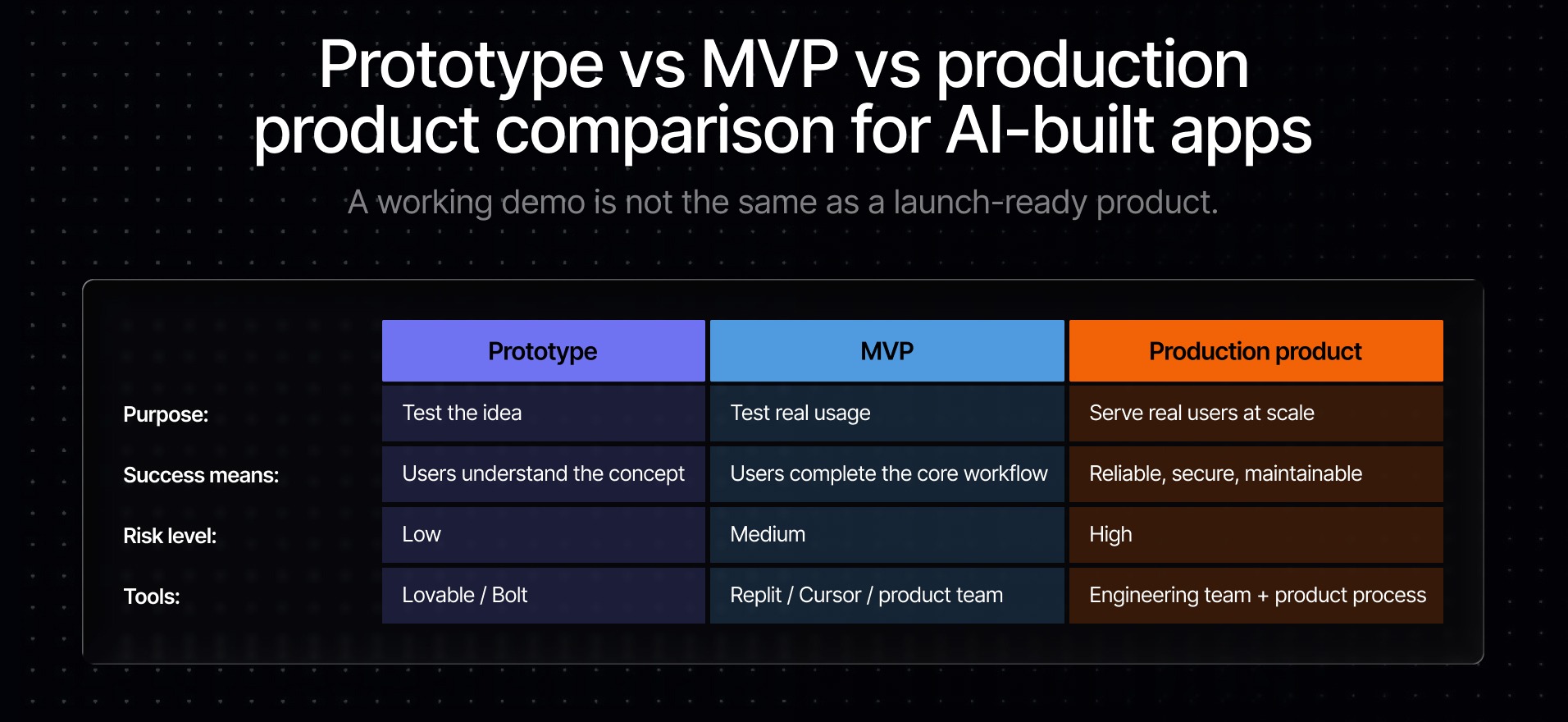
Founder decision framework: prototype, MVP or real product?
The further you move up the ladder, the more expensive mistakes become.
At the idea stage, speed is the advantage. Use the tools. Generate screens. Test flows. Send demos. Learn quickly.
At the prototype stage, UX matters. The question is whether users understand the value and can complete the core journey.
At the functional MVP stage, reliability starts to matter. You need analytics, authentication, QA, real data flows and enough technical review to avoid obvious problems.
At the investor-ready MVP stage, the product has to tell a story. It needs a clear user journey, credible architecture, strong demo flow and a roadmap that makes sense.
At the production stage, vibe coding is no longer enough. You need scalable architecture, security, monitoring, QA, accessibility, performance and maintainable engineering.
This is where many founders get trapped.
They use AI to build a demo. The demo works. Then users ask for features, investors ask about the product, and suddenly the founder is standing on top of a codebase they do not understand.
Can you build a real MVP with Lovable, Bolt, Replit or Cursor?
Yes, but it depends what you mean by MVP.
A simple MVP can be built with these tools if the goal is to test demand, collect feedback, demo a workflow or validate a product hypothesis.
For example:
A founder can use Lovable to test a SaaS dashboard concept.
A product manager can use Bolt to create a visual prototype for internal approval.
A technical founder can use Replit to build and deploy a simple functional app.
A developer team can use Cursor to speed up production development.
But if the MVP involves payments, sensitive data, complex user roles, AI workflows, RAG, agents, integrations, security requirements or investor due diligence, the tool is only part of the process.
A 2025 / 2026 benchmark of prompt-to-app systems found that these tools are not interchangeable. The study compared Replit, Bolt and Firebase Studio across human-centred criteria including ease of use, visual appeal, perceived completeness and user trust. It also highlighted a persistent gap between visual polish and functional reliability.
That is the key point for founders.
A vibe-coded MVP can prove interest. It does not automatically prove product readiness.
Where these tools break down
Lovable, Bolt, Replit and Cursor are powerful. The problem is not that AI tools are bad.
The problem is that product development is not only coding.
AI-generated apps often break down around the things that are harder to see in a demo:
Weak product strategy
Unclear user journeys
Messy code
Security gaps
Missing analytics
Poor accessibility
No QA process
Shallow integrations
Weak data model
Scaling issues
Technical debt
Hallucinated or unnecessary code
No investor-ready product story
The risk is not always obvious at the beginning.
A screen can look polished. A button can work. A flow can run during a demo. But that does not mean the product is ready for real users, customer data or commercial pressure.
Research on AI IDE-generated large-scale projects makes this point clearly. A 2026 study on Cursor-generated projects notes that AI-powered IDEs are increasingly perceived as capable of producing project-level code, but empirical evidence on their ability to generate large-scale software systems and maintain design quality is still limited.
Another 2025 study on LLM agent assistance found a significant but transient increase in development velocity after adopting Cursor, alongside persistent increases in static analysis warnings and code complexity.
That does not mean founders should avoid these tools.
It means they should understand the trade-off.
AI can help you move faster. But speed without product judgement can turn into product debt.
Built something with Lovable, Bolt, Replit or Cursor? Fourmeta can audit it before technical debt turns into product debt.
When you should stop vibe coding and bring in a product team
You do not need a product team for every idea.
If you are still exploring, use the tools. If you are validating, keep the scope small. If you are launching to real users, audit the product. If you are raising, selling or scaling, bring in product and engineering judgement.
Not at the “I have a random idea at midnight” stage.
At that stage, use Lovable. Use Bolt. Use Replit. Build fast. Learn cheaply.
Fourmeta fits when the prototype starts becoming important.
When it needs to support a fundraising conversation. When it needs to go in front of real customers. When it needs payments, roles, data, AI logic or integrations. When the UX needs to be clearer. When the architecture needs review. When the founder needs to know whether to rebuild, refactor or keep going.
A working demo is not the same as a launch-ready product.
Best tool by founder type
Best tool by product stage
Best for idea exploration: Lovable or Bolt
At the idea stage, you are not trying to build the final product. You are trying to reduce uncertainty.
Can this idea become a product? Can users understand it? Can you explain the core workflow? Does the first version feel useful?
Lovable and Bolt are good here because they help you make the idea visible quickly.
Best for visual prototype: Bolt or Lovable
If the main output is a demo, landing page, interface concept or clickable flow, Bolt and Lovable are strong options.
Choose Bolt when visual speed matters most.
Choose Lovable when you want a more web-app-oriented prototype through chat.
Best for functional MVP: Replit or Cursor
If the product needs to run, store data, support simple backend logic or be deployed, Replit becomes more useful.
If you have engineering capability, Cursor is stronger because it fits into real development workflows.
Best for investor-ready MVP: AI tool plus product team
If you are raising money, the MVP is not only software. It is part of the story.
Investors will look at:
What problem you are solving
How the product works
What users can do
How credible the roadmap is
Whether the product can become scalable
Whether the team understands the technical risk
This is where product strategy, UX and architecture review matter.
Best for production product: engineering team
Production requires more than generated code.
You need:
Architecture
QA
Analytics
Security
Monitoring
Accessibility
Performance
Documentation
Deployment processes
Maintainable engineering
AI can support this work. It cannot replace accountability for it.
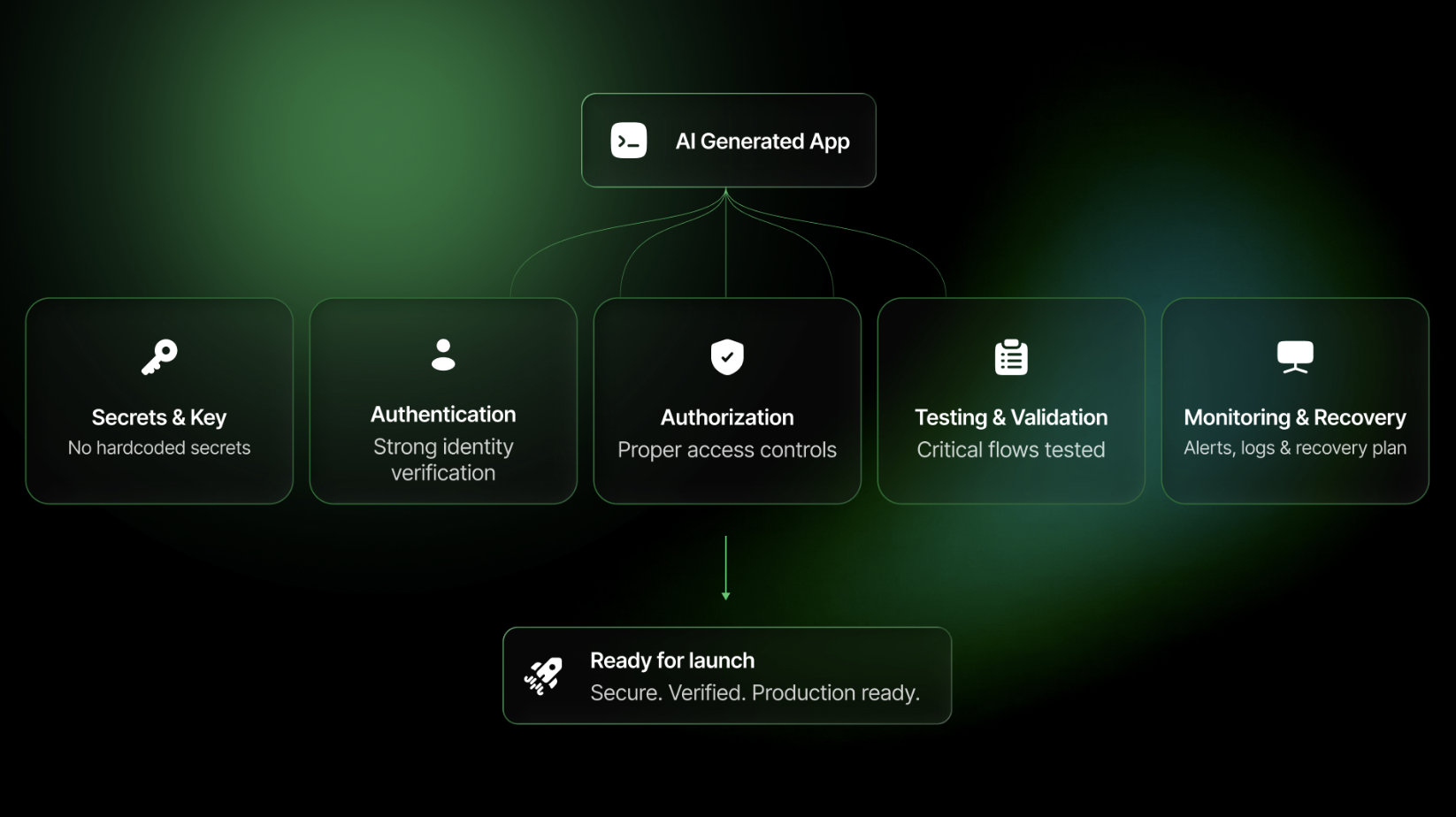
Production-readiness checklist for AI-built MVPs
Before launching an AI-built MVP to real users, ask:
Is the core user journey clear?
Can users complete the main action without help?
Is authentication implemented properly?
Are roles and permissions clear?
Are payments tested?
Is sensitive data protected?
Are integrations stable?
Do you have analytics on the core funnel?
Do you know which events matter?
Has the codebase been reviewed?
Is there a QA process?
Is the product accessible enough for your target users?
Can the product handle expected traffic?
Can the team safely change the product later?
Do you know what to rebuild, refactor or keep?
If the answer is mostly “no”, you may still have a useful prototype.
You just do not have a launch-ready product yet.
Lovable vs Bolt vs Replit vs Cursor: final recommendation
Choose Lovable if you want the fastest path from idea to web app prototype.
Choose Bolt if visual speed and front-end experimentation matter most.
Choose Replit if you want to build, run and deploy a functional app in one place.
Choose Cursor if you or your team can code and want AI inside a serious engineering workflow.
Choose Fourmeta if the prototype needs to become a real product: validated, designed, engineered, tested and ready for users, investors or customers.
The best founders will not ask, “Which AI coding tool is best?”
They will ask:
“What stage am I at?” “What risk am I trying to reduce?” “What should be fast?” “What needs expert review?” “What happens after the demo works?”
That is the real advantage.
FAQ
Which is better: Lovable or Bolt?
Lovable is usually better for non-technical founders who want to build a web app prototype through chat. Bolt is usually better when fast visual generation and front-end experimentation matter most. The better choice depends on whether you need a web app concept, a visual demo or a lightweight MVP.
Is Replit better than Lovable for building an MVP?
Replit can be better for functional MVPs because it gives you a build, run and deploy environment in one place. Lovable is often better for fast early-stage prototyping. If your MVP needs to run with real users, Replit may be a stronger option, but it still needs product, architecture and QA review.
Is Cursor good for non-technical founders?
Cursor is not ideal for non-technical founders working alone. It is designed for developers and technical teams who want AI inside a real coding workflow. A non-technical founder may get more value from Lovable, Bolt or Replit at the early validation stage, then bring in technical help later.
Can I build a SaaS MVP with Lovable?
Yes, you can use Lovable to build a SaaS MVP or SaaS prototype, especially if the product is simple and the goal is to validate the concept. But if the SaaS product includes payments, complex roles, sensitive data, integrations or scaling requirements, you should get the product and codebase reviewed before launch.
Can I build a production app with Bolt or Replit?
You can build functional apps with Bolt or Replit, but production readiness depends on the product’s complexity, code quality, security, data model, integrations, QA and architecture. A generated app should be reviewed before it becomes business-critical or customer-facing.
What is the best AI coding tool for startup founders?
For non-technical founders, Lovable is often the fastest starting point. For visual prototypes, Bolt is strong. For functional build-and-deploy workflows, Replit is useful. For technical founders and developer teams, Cursor is usually the better fit. The best AI coding tool depends on founder skill level and product stage.
What is the difference between vibe coding and no-code?
No-code usually means building with visual tools, templates and pre-defined logic. Vibe coding means using natural language prompts and AI coding tools to generate or modify software. No-code limits you to what the platform supports. Vibe coding can create more flexible outputs, but it can also create code quality, security and maintainability risks.
When should I hire a product development agency instead of using AI tools?
Hire a product development agency when the prototype needs to become a real product. Common triggers include payments, authentication, dashboards, user roles, AI workflows, sensitive data, investor demos, enterprise buyers, performance requirements or a codebase you do not trust.
Can Fourmeta help improve a vibe-coded prototype?
Yes. Fourmeta can audit an AI-built prototype, review the UX, assess product logic, identify technical risks and turn the prototype into a clearer MVP roadmap. The goal is not always to rebuild everything. Sometimes the right move is to clean up, refactor, validate or narrow the scope.
How do I know if my AI-built MVP is ready to launch?
Your AI-built MVP may be ready to launch if the core user journey works, analytics are in place, sensitive data is protected, payments and authentication are tested, the codebase has been reviewed and the product can be changed safely. If the demo works but the product is fragile, unclear or risky, it needs an audit before launch.
Final takeaway
Lovable, Bolt, Replit and Cursor are not replacements for product strategy. They are accelerators.
Use them to move faster, but do not confuse a generated app with a validated product.
The best founders in 2026 will not be the ones who avoid AI tools. They will be the ones who know when to use them — and when to bring in product, UX and engineering judgement.
Subscribe for insights, service updates, and a closer look at the world of Fourmeta®
Discover firsthand experiences from our clients about their journey with Fourmeta®Agency—insights into our collaboration, expertise, and results delivered.
Thank you for subscribe!
Oops! Something went wrong while submitting the form.




.avif)




















.avif)


